/nav-logo-desktop.webp "Marketing Architects")

/LinkedIn_icon_2026.png)
/email_icon_2026.png)
Targeting Precision is Overrated for Connected TV Advertisers
-
Hypertargeting on Connected TV consistently underperforms broad-reach strategies. Marketing Architects' data shows response declines as frequency rises on narrow audience segments.
-
Third-party audience data used for CTV targeting has an accuracy problem. Truthset estimates CTV advertisers will waste $7.36 billion due to poor data quality.
-
Marketing Architects built Smart Targeting, a CTV audience approach that replaces third-party guesswork and IP-based targeting pitfalls with first-party data and real marketplace signals.
-
Strong TV creative that earns broad relevance outperforms precision-targeted mediocre ads.
Targeting became the organizing principle of modern marketing for good reasons. Understanding your audience shapes better products, sharper messaging, and smarter strategy. Using that audience knowledge to guide where and how you buy ads is genuinely valuable. Done well, it connects the right message to the right environment at the right time.
The problem is what happens when targeting gets taken too far.
Over the past decade, the industry's appetite for precision crossed into something different: hypertargeting. The assumption was that extremely narrow audience targeting drove efficiency.
Research suggests the opposite. The data quality powering most hypertargeting strategies is far shakier than the industry assumed. The channels built on precision are extracting fees that don’t justify the return. And the brands investing in broad reach are consistently outperforming the ones chasing tighter segments.
This piece is about our obsession with extreme precision in media targeting and how it’s costing us more than we think.
Why CTV Audience Data Is Less Accurate Than Advertisers Assume
The case for tight media targeting has always relied on the assumption that the audience data powering your campaigns is accurate. If only that were true.
A study on gender-based targeting found average accuracy at just 42%. Research from Truthset found that the average email to IP address match accuracy is 16%. In a separate survey from Adverity, CMOs estimated that 45% of the data their teams use to make decisions was inaccurate in some way.
Nearly half. That's a whole lot more than a rounding error. And yet the industry doubled down. Why?
Starting in the mid-2000s, behavioral cookies and mobile device identifiers gave advertisers the ability to follow a specific person across the internet, serve them a targeted ad, and record what they did next. For the first time, ad spend looked like a direct lever for revenue.
Platforms had a financial incentive to reinforce that belief. Google, Meta, and Amazon built ad products on granularity. More targeting means more value means higher CPMs. Multiple studies have confirmed that roughly half of each dollar goes to actual ad spend. The rest goes to intermediaries, many of whom justify their fees through targeting complexity.
But precision didn't necessarily make campaigns more effective. It did make the supply chain more profitable.
There's also a psychological pull. Last-click measurement and automated reporting dashboards gave marketers numbers they could bring to the CFO. Marketing felt tangible and trackable in ways that weren’t accessible in the past.
But there's a name for this pattern: strategy surrogation. Accounting researchers Willie Choi, Gary Hecht, and Bill Tayler coined the term for the moment a team starts treating a performance metric as the strategy itself, rather than a signal of it. An upward-moving metric feels like evidence of success, even when it's measuring correlation instead of causation.
Bad data and misaligned incentives explain how hypertargeting became the default. But they don't fully explain why it stayed there. For that, you need to look at the assumptions underneath the strategy. Let’s look at three that feel so intuitive they rarely get questioned.
3 Marketing Myths Keeping Targeting Broken
Myth #1: Reaching only your target customer is more efficient than broad reach.
Why pay to reach someone who would never buy from you?
The problem is that this belief only holds if your category buyers are a static, easily identifiable group. When you build a hypertargeting strategy, you almost always end up over-indexing on heavy buyers, or the people who already purchase frequently in your category. They show up in your data because they're engaged. But they're already buying. They don't need to be convinced.
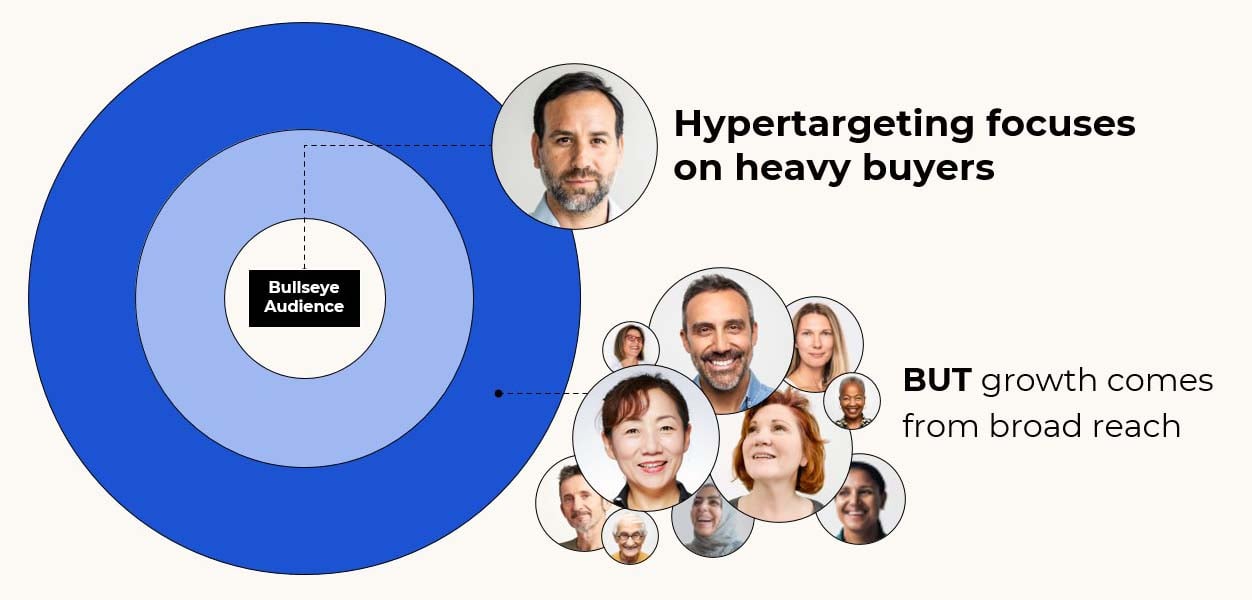
The Ehrenberg-Bass Institute has spent decades studying how brands grow, concluding that long-term growth comes from light buyers. These are the people on the periphery of your category, not at the center of it. Data shows that most category buyers purchase only once or twice a year. Building mental availability with those people, before they enter the market, is how brands compound market share over time.
Plus, tight targeting doesn't just limit who you reach. It changes how often you reach them. When your audience pool is small, frequency shifts fast. The same budget that would spread across a broad audience gets concentrated on a narrow one. Impression stack up on the same people. This frequency problem is especially visible on Connected TV.
When streaming TV arrived, it promised digital’s targeting capabilities delivered in TV's high-attention environment. Advertisers responded by doing what they'd been trained to do. They optimized for the audience slice that looked most like their existing customers.
The result, in many cases, is that CTV campaigns hit the same small group of households over and over. Marketing Architects data shows that response declines as frequency rises, with ROI on each additional impression decreasing. There are brand recall and conversion benefits to repeat exposure, up to a point. But past that point, high frequency just starts irritating the people you're trying to impress.
Myth #2: More audience data means better targeting.
Data quality and data quantity are not the same thing. And in third-party audience data, the gap between the two is significant.
Truthset's research on third-party audience accuracy across major data providers found that segments sold as representing specific audiences, by age, gender, income, and interest frequently fail accuracy tests. They're built from probabilistic inferences, not verified data.
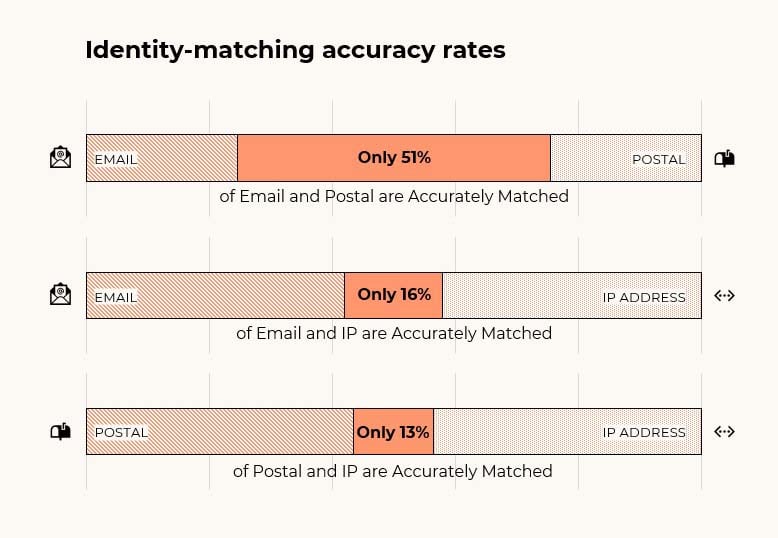
On Connected TV, this problem is compounded by the nature of the medium itself. CTV targets households, not specific individuals. Streaming's notorious account-sharing problem means your ad could easily reach your true target’s college student or their best friend instead. And even if you reach the right TV, there’s no guarantee your ideal target is the one actually watching.
And while IP addresses are widely used to identify and reach specific households, the IP address alone is typically worthless. To do anything useful, the IP must be mapped to a consumer profile built from a combination of first- and third-party data, both of which carry additional costs and errors. The financial cost is significant. Truthset recently reported that CTV advertisers are on track to waste $7.36 billion in 2026 due to poor data quality.
The infrastructure supporting all of this is also getting less stable, not more. IPs change more frequently than most targeting models account for. Dynamic IP assignment, VPN usage, and mobile network switching mean the IP captured yesterday may belong to a completely different household context today.
Privacy regulations like CCPA, Apple's ATT, and the deprecation of third-party cookies have also reduced the volume and quality of data flowing into audience segments. eMarketer reports that most consumers have used privacy tools to prevent the tracking on which precise targeting depends.
Myth #3: Hypertargeting is needed for advertising relevance.
The assumption is that an ad must feel personally built for the viewer to work. Tight targeting is presented as the path to perceived relevance.
A meta-analysis published in the Journal of Advertising Research examined 53 studies with nearly 12,000 participants and found that personalized ads do outperform generic ones. But the effect is small. And when researchers dug into why personalization worked, it wasn't targeting mechanics driving the shift. It was the creative itself.
An excellent ad reaching a broad audience outperforms a mediocre ad reaching a perfectly defined target. And unfortunately, advertisers are simply not making enough excellent ads.
System1 put a number on the creative quality gap with their Cost of Dull report. According to their research, US brands would need to spend an additional $189 billion annually to make dull ads as effective as top creative work.
What marketers often confuse is cultural relevance with audience segmentation. Making sure creative doesn't feel tone-deaf to a particular group is good creative. Building 30 versions of an ad for 30 behavioral micro-segments is expensive, slow, and often unnecessary.
Television is where this plays out compellingly. A well-crafted TV ad doesn't derive relevance from knowing who's watching. It earns relevance through the quality of the story it tells. Emotion, character, and narrative story appeal to humans broadly. A heartwarming ad is heartwarming to most people. A story that builds a mental shortcut to a brand does that for nearly everyone who sees it.
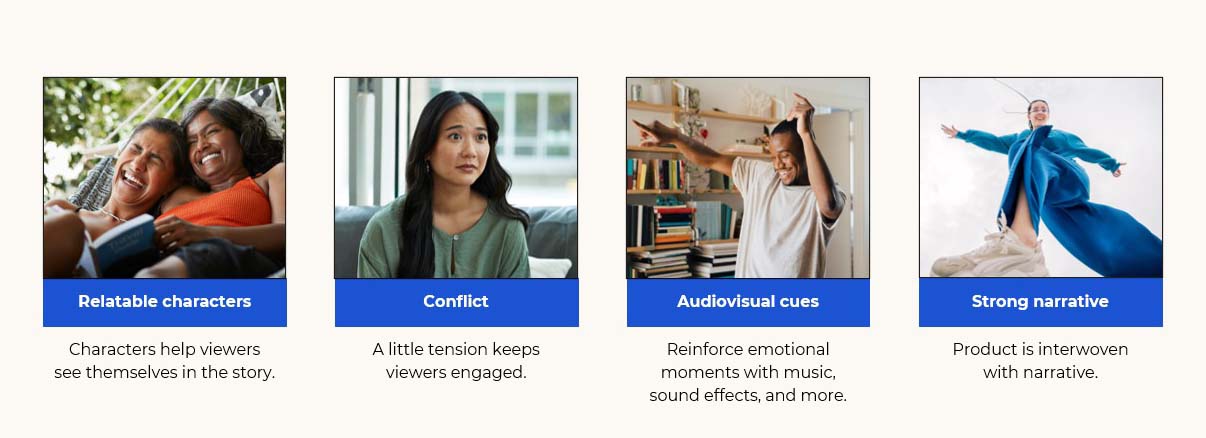
TV's format reinforces this. 30 uninterrupted seconds is genuinely rare in modern media. It's enough time to make someone feel something, which is what drives both immediate response and long-term brand memory. Research from the IPA consistently shows that emotionally resonant campaigns generate stronger business effects than rational, feature-heavy advertising, and that those effects compound over time.
That doesn't mean TV creative has to be one-size-fits-all. Marketing Architects uses a tool called Mass Customizer to create multiple versions of the same Connected TV ad. The master creative stays intact: the story, the cast, and the core message don't change. What changes is the context around it. The AI layers in details like local weather, regional offers, nearby store locations, or the season, so the same 30-second film can speak differently to a viewer in Phoenix than to a viewer in Boston without a second shoot day. The result is relevance that's earned through smart, subtle adaptation rather than one-to-one personalization.
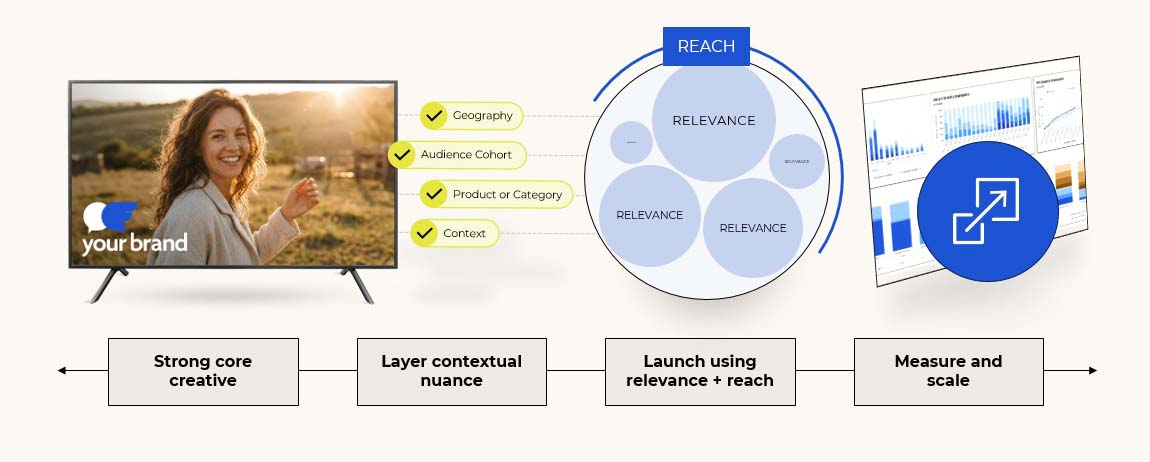
What does a smarter targeting strategy look like?
At Marketing Architects, we believe rejecting precision doesn't mean abandoning targeting, especially on Connected TV. The goal is getting targeting right.
The first move is embracing "positive spill," the brand-building value that comes from reaching people just outside your core bullseye: purchase influencers, light buyers, and future buyers. When media reaches your core audience, it also reaches those adjacent groups. Media strategies targeting exclusively within a tight bullseye sacrifice that spill in exchange for precision that, as established, is frequently illusory.
The second move is choosing data signals that can actually be trusted. Genre. Geography. First-party audience data from your own CRM. These signals are grounded in real behavior rather than modeled inferences built on identity guesses.
Marketing Architects developed Smart Targeting for CTV advertisers with this in mind. Rather than paying for third-party audience segment fees, Smart Targeting combines two data inputs: your first-party data, including pixel traffic, CRM data and order signals, overlaid with real marketplace signals like ZIP code, genre, daypart and app usage. That combination maps where your highest-value customers are actually watching. From there, our media-buying AI places media in those environments. The result is smarter allocation and stronger ROI, without the accuracy risk or the added cost of third-party targeting. In head-to-head comparisons, Smart Targeting has delivered a 2x performance advantage over traditional third-party methods.
But if you are using third-party audience segment data, take the time to vet your data provider. Ask how frequently segments are refreshed, how many data sources they pull from, and how identity graphs are maintained. The accuracy gap between providers is significant. It’s worth finding a partner invested in getting as close to the truth as possible.
The third move is investing in creative that earns broad relevance without requiring narrow audiences. Emotional storytelling, relatable characters, strong narrative and distinctive audiovisual cues work across audiences. Customization should add contextual nuance to a strong master concept, not replace the creative entirely.
Why CTV Should Be Treated as a Reach Channel First
For most of TV's history, targeting was simple. Advertisers bought demographics. Adults 25-54. Women 18-49. The audience was broad by design, and that scale is what made TV the most effective brand-building channel ever developed.
Connected TV changed the conversation. When advertisers brought their hypertargeting instincts to CTV, they made the channel operate more like a digital retargeting medium than a reach format. It saw narrow audiences, heavy frequency, rising CPMs, and diminishing returns.
That's a problem, because TV's power was never precision. It was presence.
The average US adult watches close to four hours of television a day, according to Nielsen. Streaming accounts for nearly half of that time. The scale is there.
This is where incremental reach becomes the right mindset for evaluating CTV investment. The goal isn't to find only your existing customers on a new screen and show them more ads. It should be to reach people who haven't encountered your brand yet. Those light buyers, future buyers, and purchase influencers that hypertargeting filters out are exactly the audience that drives long-term growth.
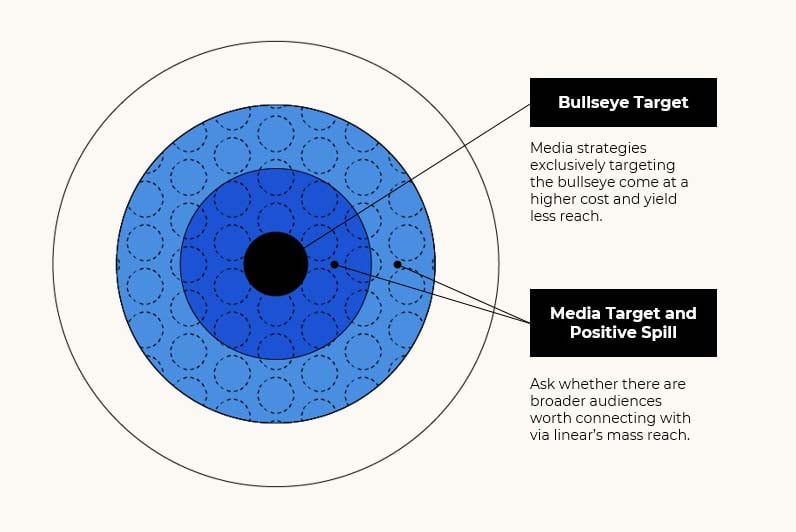
The instinct to hypertarget on CTV is understandable. The tools exist. You might even get numbers that look great in a dashboard.
But the brands getting the most out of Connected TV are the ones treating it the way the medium was always meant to be used: as a reach channel first, with targeting applied thoughtfully to improve placement quality, not to shrink the audience down to a list. That’s how you get numbers that the whole business feels.
Dig into targeting strategies that actually work for TV advertisers.
Tune into a live session hosted by Adweek and Chief Marketing Officer Elena Jasper to talk through what actually works when you're trying to reach the right people at the right time on TV.
---
Marketing Architects is an All-Inclusive TV advertising agency helping brands grow by reaching new customers and building mental availability.

The Marketing Architects Team
Curated by our leaders, creatives, analysts, designers, media buyers and more at Marketing Architects.