/nav-logo-desktop.webp "Marketing Architects")

/LinkedIn_icon_2026.png)
/email_icon_2026.png)
B2B Marketing Needs to Rethink Reach, TV and Mental Availability
-
95% of potential B2B buyers aren’t shopping right now. Most B2B budgets overfund targeting the 5% of buyers who are.
-
Growth depends on being known before buyers start evaluating.
-
TV remains one of the most effective ways to build mental availability at scale.
-
The Demand Gap Calculator estimates your in-market vs. out-of-market split. Available now automatically for B2C brands, with a custom analysis option for B2B.
Picture your ideal buyer. Senior title. Real budget. A clean match to your persona deck.
Now imagine that six months from now, they begin evaluating vendors. They create a shortlist, pull in colleagues, and narrow options.
Your brand never makes the list. Not because your product isn't right for them. Because you were never top of mind.
That's not a sales problem or positioning issue. It's a reach failure. And most B2B marketing plans actively reinforce it.
Why do B2B marketers fall for the 5% trap?
The dominant logic in B2B marketing is simple: find the people who are ready to buy and get in front of them first. It's a reasonable instinct. It's also why so many growth plans eventually stall.
At any time, most potential buyers aren't looking for what you sell. They're not comparing vendors, filling out contact forms, or requesting budget approval. The 95:5 rule from Ehrenberg-Bass and The B2B Institute says 95% of potential B2B buyers are out-of-market at any given moment. That leaves just 5% actively shopping.
And every one of your competitors is fighting for that same 5%.
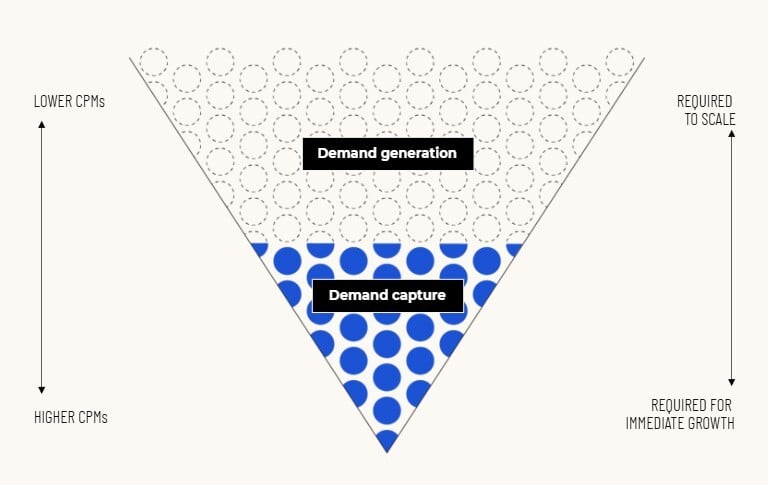
What does the 95:5 rule mean for B2B advertising?
Performance marketing captures existing demand. Paid search. Retargeting. Account-based display. LinkedIn lead forms. All designed to intercept buyers already looking for your solution.
The problem is simple. Every competitor is targeting the same sliver of in-market buyers. Especially in niche B2B segments, the math gets brutal fast. There are only so many HR directors at SaaS companies under 100 employees, IT managers at rural hospitals, or procurement leads at PE-backed manufacturing firms.
If 95% of them aren't interested right now—and you have no way of predicting which of them will be interested in three months, six months, a year—you're going to run into diminishing returns on performance tactics.
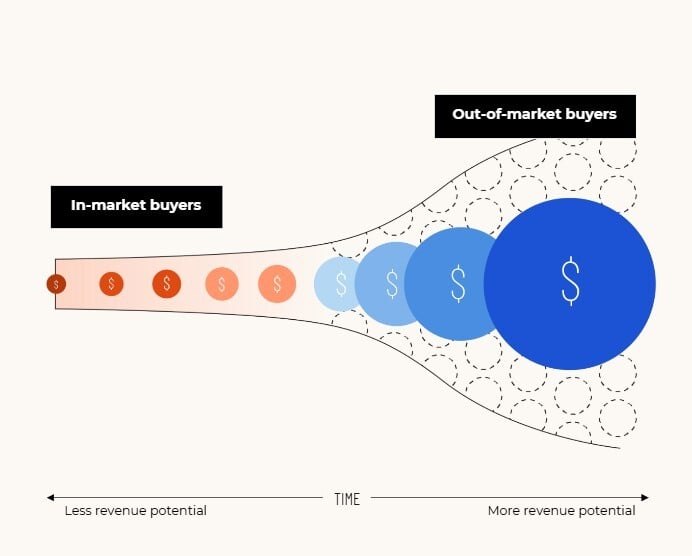
B2B product differentiation is getting harder.
There's another wrinkle.
Dentsu's Superpowers Index found that 62% more brands are considered in a typical B2B purchase decision compared to 2021. Today's buyers have more options than ever. And those options are more similar than ever.
AI has accelerated feature parity across many categories. What used to be defensible for years can now be copied in months.
“Product is not a moat anymore. You cannot keep a product very differentiated. It's very easy to copy. So product differentiation is eroding, and brand is the differentiation that's left.”
—Liam Moroney, Owner of Storybook Marketing
This means that breaking through to that 5% has never been harder or more expensive. Which is why the real growth opportunity isn't the 5%. It's ensuring that the 95% will think about you first when they eventually enter the market.
Mental availability wins in B2B, too.
Buyers don't start from scratch when they’re ready to purchase. The brands they already know and trust are considered first. 86% of B2B buyers report having a "day one" list of brands in mind before they even start actively shopping. And 92% of buyers with an initial list ultimately purchase from it.
That’s why mental availability matters. Coined by The Ehrenberg-Bass Institute, “mental availability” refers to the strength of a brand’s memory structures. Or, how likely is your brand to be considered in a purchase scenario?
“We are trying to reach future buyers before they're ready to buy, and we're trying to build some kind of memory with them that makes our brand easy to think of when that moment actually comes.”
—Matt Maynard, VP Global Brand & Advertising at Asana
Mental availability is built through consistent brand presence. Creative should use the same messaging and distinctive brand assets. And yes, media plans should be built for broad reach. Because your customer base is likely larger than you think.
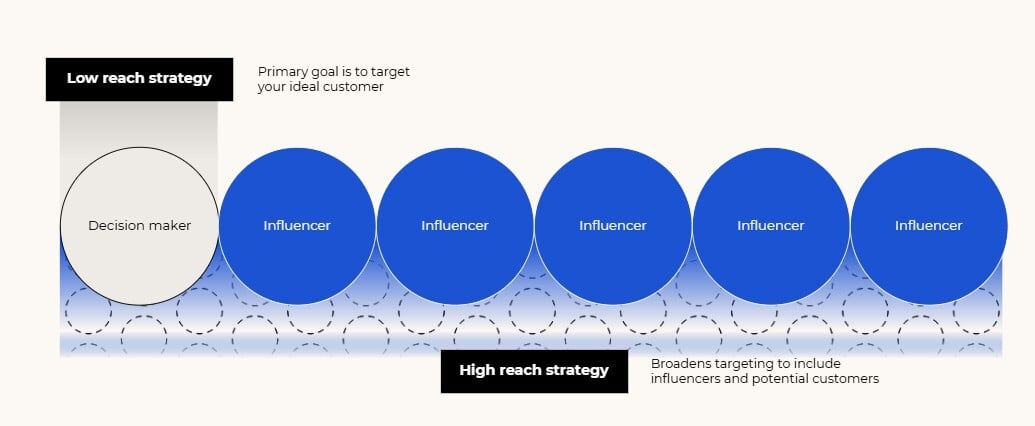
B2B marketing has a hidden buyer problem.
Gartner reports that the average B2B purchase now involves six to ten people. Every one of those stakeholders brings their own experiences, preferences and prior brand exposure to the table. This makes it harder for a B2B marketer to predict who is making or influencing the purchase decision.
Complicating the process further are "hidden buyers," or people who hold sway over whether a deal closes but rarely show up in your CRM or download your white papers.
According to The B2B Institute, 40-60% of deals stall because a hidden buyer wasn't sold. And the reason is rarely product features. They’re concerned with process and mitigating risk. For them, familiarity and reliability are deciding factors.
You cannot reach hidden buyers with persona-based digital targeting. These buyers aren’t attending your webinars or responding to your outreach sequences. The only realistic way to build familiarity with this audience is through broad reach marketing over time.
"Do we need to shift from thinking like hunters to thinking like farmers? That means moving away from short bursts of conversion-focused activity towards building a consistent, memorable presence over time."
—Angela Voss, CEO at Marketing Architects
Here’s why “Nobody ever got fired for buying IBM.”
There's a persistent myth in B2B marketing that buyers act on logic alone. They read spec sheets, compare features, and choose the objectively best option. Research tells a different story.
B2B buyers are people. People make decisions based on familiarity, trust, and emotional confidence. In an environment where budget decisions face scrutiny and the wrong decision could cost you a job, the safest choice isn't always the best product. It's the brand everyone has heard of. The one that already feels credible.
That kind of trust isn't built through a single search ad. It builds through storytelling before buyers ever enter the market.
87% of B2B marketers believe their products can be inspirational. The brands willing to act on that belief, investing in emotionally resonant marketing at scale, are the ones earning that trust with the 95% who aren't shopping yet.
That doesn’t mean wishy-washy marketing goals. It means a calculated investment in scaling your future success as demand grows.
And surprisingly, TV advertising might just be the best way to achieve that.
The case for TV advertising in B2B.
TV is often dismissed in B2B planning cycles. The assumption is that B2B audiences are too narrow, too niche, too specialized.
That hesitation is outdated.
When Google is your primary awareness channel, you’re discovered alongside competitors in a high-intent auction. TV flips that dynamic. It introduces your brand before the search begins, combining reach, attention, and credibility.
TV delivers:
-
High ad recall relative to mobile and social. Research from Comcast and MediaScience shows TV ads produce 2.2x higher ad recall than mobile ads. TV also commands significantly more visual attention than YouTube, Facebook, or Instagram. If your goal is to be remembered months later when a buying committee forms, that attention matters.
-
Strong visual and audio storytelling. Common B2B digital ad formats compress messaging into six seconds, static images, or gated PDFs. TV gives you 15 or 30 uninterrupted seconds to tell a story. Research shows that emotional, story-driven campaigns drive stronger long-term business effects than rational, feature-heavy advertising alone, especially when brand trust is crucial.
-
Inherent credibility. There's a dimension to TV advertising that rarely shows up in a ROAS calculation: what it signals. Consumers consistently rank TV among the most trustworthy advertising channels.
Part of this comes down to regulation. TV advertisers must substantiate their claims. Buyers know this, even if subconsciously. Seeing a brand on TV communicates that the brand is legitimate enough to be there.
For B2B brands with especially narrow buying audiences, Connected TV offers a smart entry point into TV advertising. CTV provides:
-
Visibility across high-quality streaming environments to build familiarity among out-of-market buyers.
-
Geographic or audience refinements to reduce spill.
-
Retargeting viewers who’ve already encountered your brand.
CTV also lowers the barrier to entry. Brands newer to TV can start with streaming placements, measure response against site traffic or pipeline movement, and build confidence before expanding investment.
Perhaps the biggest misconception B2B buyers have about TV is that it can’t drive immediate results. But brand and performance aren't in tension here.
The IPA’s “The Long and the Short” shows that campaigns balancing brand-building and activation generate stronger overall profitability than short-term performance alone. TV remains one of the few channels consistently present in most of the most effective campaigns, generating sales response and lasting, sustainable growth.
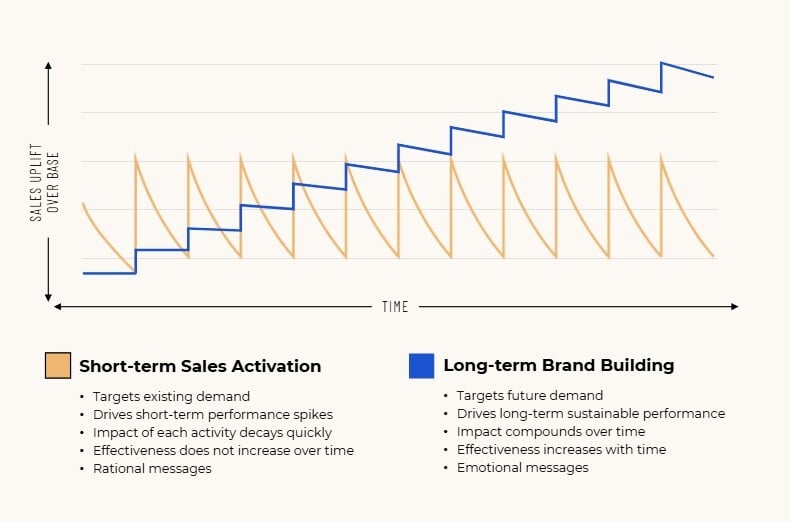
For B2B brands facing shrinking product differentiation and rising digital costs, that combination of brand and sales is vital. The same investment that builds memory structures with future buyers can also make today’s in-market buyers more likely to convert.
That’s how reach translates into revenue.
Your brand’s exact audience split probably isn’t 95:5.
The 95:5 rule is a heuristic, not a law, and it applies across B2B and B2C alike. The actual ratio of in-market to out-of-market buyers varies by category, and the right strategy depends on where your category falls.
Knowing your actual split is the first step to allocating budget against the real opportunity, rather than an assumed one.
The Demand Gap Calculator was built to make the 95:5 rule concrete and practical. Grounded in effectiveness research and validated with MRI-Simmons data, it estimates a brand's unique split between in-market and out-of-market buyers. B2C brands can try it free today. B2B brands can connect with our team for a custom analysis that accounts for your category's buying complexity.
---
About Marketing Architects
Marketing Architects is an agency helping established B2B brands drive growth through efficient, accountable TV advertising across linear and streaming.

The Marketing Architects Team
Curated by our leaders, creatives, analysts, designers, media buyers and more at Marketing Architects.