
Episode 184
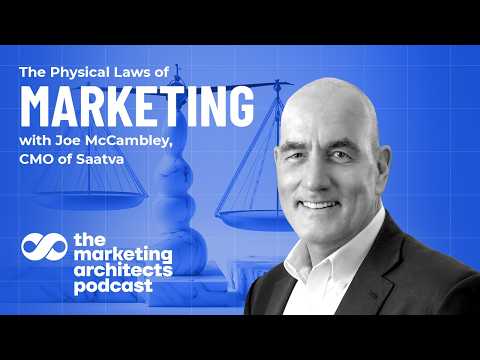
The Physical Laws of Marketing with Joe McCambley, CMO of Saatva
Saatva grew to more than $150 million on one channel: non-branded search. Then hundreds of competitors flooded the mattress category and costs skyrocketed.
This week, Elena, Angela, and Rob are joined by Saatva CMO Joe McCambley to talk about what happened next. Joe explains the statistically significant relationships he tracks between channels, why $200,000 a month in podcast advertising moved branded search within weeks, and how a WARC-led curriculum got his board comfortable with upper funnel spend. Plus, hear why he'd rather blanket the universe than target individual consumers.
Topics Covered
• [03:30] The physical laws that predict brand growth
• [07:00] What forced Saatva up the funnel
• [15:00] Owning restorative sleep in a crowded category
• [18:45] How the Olympic sponsorship came to be
• [23:15] What marketers should look for in a CEO
• [29:00] Mining 150,000 sales calls with AI
• [32:15] Joe's most contrarian marketing opinion
Resources:
2026 ClickZ Article
Joe McCambley's LinkedIn
Today's Hosts

Elena Jasper
Chief Marketing Officer

Rob DeMars
Chief Misfit

Angela Voss
Chief Executive Officer

Joe McCambley
CMO of Saatva
Transcript
Elena: I'm Elena Jasper. I run the marketing team here at Marketing Architects, and I'm joined by my co-hosts, Angela Voss, the CEO of Marketing Architects, and Rob DeMars, the Chief Misfit at Misfits & Machines.
Angela: Hello.
Rob: Hello.
Elena: And, oh, hello. And as you heard, we have a guest joining us today. Joe McCambly is the chief marketing officer at Saatva, a restorative sleep brand. He was formerly the chief creative officer at Digitas, ran a massive creative organization at AOL, and co-founded The Wonder Factory, which built the original Huffington Post, redesigned WebMD, and shipped the first iPad apps for Time and Sports Illustrated. Lots of cool stuff there. He joined Saatva in 2017 and has been CMO since 2018. So Joe, thank you so much for joining us.
Joe: Oh my gosh, thank you for having me. I feel like this is like a moment of arrival for me as a marketer. If at the end of this podcast I die, they're gonna put my photo in a church with like Marketing Architects logo over it, and people are gonna come into the church and they're gonna say, "He was a wise man. He was such a great man." So thank you for having me.
Rob: Wise man, and from what I hear, similar to Elena and Angela, you are a tall human. That, the rumor on the street. Now, tall people either sleep terribly because no bed on earth will fit them, or they become the CMO of a mattress company so they can finally fix it. So which one is it?
Joe: I joined to get the free bed, and the unintended consequence is that I can fall asleep in five minutes and literally sleep for 10 hours anytime. I'm not just making that up. I'm unique in that way.
Angela: That's amazing.
Joe: Elena, Angela, can you do that?
Angela: I can fall asleep in seconds and sleep amazing for about four hours, and then I wake up and my brain wants to work on every problem known to mankind. But it's not the bed. It's the brain.
Joe: It's the brain.
Angela: Yep.
Rob: Sleep is my superpower. I could lay my head on this keyboard right now and I'll be out like a light.
Elena: Nice. I was thinking as a tall person, what I'd really like to infiltrate is airlines, get more room on airplanes. But mattresses works too.
Joe: Finally, somebody says something nice about mattresses, 'cause Angela says it's the head. Rob, you could sleep on a keyboard. None of you believe a good mattress makes sense.
Rob: Mattresses are amazing.
Elena: Yes, I believe for sure.
Joe: I wanna help your ratings, so I'm planning on swearing like a sailor during this 'cause I know that helps you.
Rob: Please do. That does help.
Elena: Yep. Well, we're back with our thoughts on some recent marketing news, always trying to root our opinions in data research and what drives business results. And I like to kick our podcast off with some research, and today I chose an interview that Joe gave to ClickZ at the LEAD Summit. This was titled "Saatva CMO on How the LA '28 Games Bet Paid Off." So from 2009 to 2017, Saatva ran essentially one channel, non-branded search, and grew to over 150 million on it. Then hundreds of competitors flooded the mattress category and costs skyrocketed. That pressure pushed them up the funnel, and Joe grounds his strategy and work in Ehrenberg-Bass research, a marketer after my own heart.
So Saatva added radio, podcast, TV, and premium sponsorships, and now they even sponsored Team USA in the Winter Olympics this past year, which I'm sure everybody saw, and they're going to sponsor the games in Los Angeles in 2028 as well. Very exciting stuff, and I wanna talk about that kind of interesting marketing you're doing. But on this show, we like covering the basics too, because so many brands are missing them. So let's start there. Joe, you believe that there are physical laws inside a business. You know, there's relationships that are predictable that every marketer has, whether they know it or not. Could you tell us a little bit about your theory of how physical laws can predict success for brands like Saatva?
Joe: Yeah, and I know there's a lot of debate about this on LinkedIn right now, so I think there's people on the Joe side and people on the anti-Joe side. But we had the luxury when I joined, like you said, Elena, we were marketing in one channel and there was a flood of competitors that came in and because of that, the cost of our non-branded search just went through the roof and we lost money. So rather than decide to get better at non-branded search, we decided to add new channels. And every time we've added a new channel, we've got really solid data going back to our founding in 2009, grounded in Google Analytics. Every time we've added a new channel, we've seen how that new channel has affected the previous channel and how the second channel affects the previous two channels. And we've noticed over time that there are some very strong statistically significant relationships. There are 20 metrics we follow, but the three that I care very much about are: one is called R squared value.
When you look at a dependent variable like TV impressions, how much of the movement in a dependent variable like branded search is affected by that independent variable, right? So we look at the R squared value, then we look at the correlation. Is it positive and negative, and is it very strong? You know, think of a curve like this. And then we look at the P value. P value measures whether or not something could happen by accident or is there really a statistically significant relationship. And we monitor those and we look at relationships across all of our channels. Right now we're in about 20 different marketing channels and we can measure the R squared, the coefficient and the P value of all of them and we know what it is and we monitor it continuously. And we know that for some channels like TV impressions and branded search, it's very strong. We know with branded search and market share, it's very strong. We know that if our aided awareness goes up, we know that we're gonna spend a predictable amount less on non-branded search because the branded search adds as the aid to get people to remember us. We know that as unaided awareness goes up, our branded search is gonna go up and our direct visits go up and it's predictable and measurable to us. So like I said, I know there's a debate on LinkedIn about whether or not this is true. I'm just saying it's true for us. We have these predictable relationships that we're measuring all the time and I've — you know, when I first joined Saatva, I came as a creative director and I thought all you really needed was really well done emotional storytelling and all your problems would go away. And I have since learned that as important as that is, it's kind of a minor factor when you look at the stats. And we're seeing that at least I believe for us, we've got these predictable relationships that we can plan the business around, and I can tie millions of dollars in incremental revenue to the way that we're measuring this data and acting upon it. And I believe it probably underlies every business that's out there, but it takes time and patience and effort and really good analysts to identify those metrics. But I think they're laws of physics.
Elena: Well, I mean, I think you're seeing it in your business results, so you've got a good case to make that that exists. One thing I wanna talk about is that moment in time when you were investing a lot in search and you were feeling these sort of headwinds, 'cause I think a lot of marketers are probably in that exact moment. Could you share some of those challenges that the business was facing at that time that kind of forced you more up the funnel? Like, what were some of those things you were experiencing?
Joe: Sure. We already talked about how branded search went through the roof, and the next natural channel that we moved to was affiliates. So think of The Wirecutter, Better Homes and Gardens, sites that recommend mattresses to consumers. And we thought that that was a natural way to grow for us because all of our affiliates use paid search as one of their primary marketing channels. So we figured, you know, we kinda know paid search. We've been doing it for 10 years or so. They do paid search. We can lean into that. It felt less threatening. It's a performance channel. We're a performance brand. So we adopted affiliate marketing on top of non-branded search, and then COVID happened, and our business went through the roof.
So people could not go into retail stores anymore, so they went to the internet, they searched, they relied on the recommendation of affiliates. We saw that affiliates lent us social proof, they lent us consumer trust, and our business just went through the roof. When COVID ended, people stopped searching for mattresses. They stopped thinking so much about self-care, and our business bottomed out. And so where we spent so much time congratulating ourselves because we were smart enough to move into affiliate marketing, we then started kicking ourselves because we were over-dependent on performance marketing. So that was the first really true signal in self-defense where we learned that we had to move up the funnel. The other big challenge we had, though, is that it was a company filled with people that, you know, performance marketing got us where we are, and it's hard to leave what got you where you are for something new. Although everybody talks about branding, everybody talks about TV, if you've only done performance marketing, it's hard to have the courage to take that leap.
We did that in fits and starts, and it got a little bit frustrating because we kept investing in TV, and then because we didn't see immediate results, we would pull back. And so what I did was, it was the first time that WARC entered my radar. We developed a partnership with WARC where I said, "Look, I need you to come in. First of all, you've got data going back to the early 80s that show how traditional performance brands have moved up the funnel. There's a roadmap we can follow, and I need you to put together education and training for our board of directors, our CEO, our COO, our CFO. I need them to start believing that moving up the funnel makes sense." So we put together a six-part curriculum, two-hour sessions with about 20 company leaders led by WARC based on research that really kind of showed that in the early days of a brand, you tend to lean into one channel that works for you. You have an existential crisis, and then you start to, as the company grows, move into different channels and measure the effectiveness of all those channels. And so that was the first time that we were able to show data to performance marketers that upper funnel advertising not only is additive to performance marketing, but it makes your performance marketing better.
And so the other thing that we learned, though, is that you can also invest too little in a channel like TV for it to make sense for you. So you have to invest meaningfully, you have to be consistent, not just in your spending and your messaging, and then you have to wait sometimes for good things to happen. So we didn't have the budgets that we needed for TV, and we dipped our toe in podcast advertising. And a big part of the WARC curriculum was that as you move up the funnel, especially if you're doing radio, podcasting, or TV, an early indicator of success is you should see movement in branded searches. So as long as your share of voice on a channel is greater than your market share, you will see market share go up. If your share of voice in a channel is less than your market share, you're doomed to see your market share go down. So for us, because our market share was under 1%, it was easy to generate that excess share of voice we needed on podcasting to start to see movement in branded search. And it actually happened for us within about a three or four-week period, where investing 200,000 a month in podcasting, about a month or two later, we saw a meaningful increase in branded search. And then literally within about 90 to 120 days, we started to see our market share start to inch up. Not tremendously, but noticeably. And so every time, two months into our podcast advertising when the performance marketers would come back and say, "I don't think this is working. We're not really generating more revenue and market share." I would say, "Yeah, but the branded search is moving, and remember what you learned in those sessions from WARC. This is progress. Hang in there." And we hung in there, and it started to pay off.
Elena: You answered my question and more. It's like music to my ears hearing a marketer talk about this stuff. We're big fans of WARC, and we've done similar training here, so definitely a smart thing to bring in experts like that.
So you mentioned a little bit about how you're measuring the impacts of your marketing. You talked about branded search, ESOV. I know a lot of marketers, when they see a brand like Saatva and you're investing in things like the Olympics and you're on TV, they really wanna know, how are you proving it works? 'Cause I think that's a complaint I hear a lot is, "I'd invest in brand if I could show it works." And I know you mentioned a couple of metrics there. Are there any other ways you're thinking about measuring those long-term impacts of your marketing investments that the business wants to see?
Joe: For most channels, there's kind of three levels of impact from a timing standpoint, and I'll start with TV, for instance. When we run TV advertising, whether it's linear or streaming, we see an immediate impact on site visits. So literally within 24 hours of running a TV spot, we're doing some IP matching, especially in streaming. We can see that the people that were exposed to our TV spot are visiting the site. Next, in about two or three months, we'll start to see affiliate traffic will increase. We'll start to see that conversion rates from affiliate traffic will increase, and we start to see branded search move pretty meaningfully after about a two-month period now.
And then at eight months, we see a maximum impact where we're seeing market share actually move. So we look at a lag effect and a horizon for all of our upper funnel investing. In the lower funnel, we're doing what everybody else is doing. We're looking at Google Analytics. We're looking at our marketing mix modeling. You know, marketing mix modeling is great, but it's backward-looking and it's very, very slow. So we're kind of supplementing the marketing mix model with that lag that we're seeing, the excess share of voice, the share of search, the branded search, the non-branded search volume, the market share movement. We're really trying to look at about 20 different metrics that we're rationalizing together. We don't make any decisions here unless we can triangulate a data point that tells us that we're right, that what we're seeing in this channel is actually being supported by two other data points that tell us we can move. That's kind of cautious. It causes you to move maybe more slowly than you would like. But what makes it easy today is that our business is up about 20% to 30%, depending upon when you're looking at it. So everybody is confident that it's working and it kind of takes the heat off.
Angela: Yeah, certainly helps when business performance is there. I think just great advice there. Related to television specifically or probably any top-of-funnel channel, it's always, I think, perplexing for marketers to think about making that jump, just thinking about how do you measure it? And especially for a channel that really is full funnel. It's gonna find those consumers that are shopping for mattresses today, they're moving or what have you, and convert hopefully more of your fair share to your brand. And then those mid-funnel metrics and those upper funnel metrics as well can be tracked. So great advice there. Joe, we opened by talking about how sleep is one of your superpowers, so perhaps that alone gives you the credibility to discuss restorative sleep, and you're working to make Saatva known as the restorative sleep brand in a very crowded category. What's your strategy to help that positioning stick?
Joe: I wish I could say I was the brilliant strategist that developed this and made it stick. But you know, the reason that it turns out to be a good strategy and it works for us is because it's true. You know, if you're an Olympic athlete like a Jessie Diggins, and you're doing long distance cross-country skiing and you're competing in an event every day for eight days straight during the Winter Games, and you're doing multi-kilometers and falling exhausted at the finish line, you are in need of restorative sleep. The way that your muscles recover, the way that your body recovers is important to you. If you're an Olympic swimmer and you're doing three events in a day, you are sleeping between those events because that helps your body restore itself. This isn't something that we knew before we decided to do the Olympic sponsorship. It's something that we learned afterwards by working with athletes that sleep really is vitally important to them. The other thing that has worked in our favor is that a lot of every mattress brand at some point will mention restorative sleep once, maybe in an email, maybe in a social post, but it's one of a thousand messages that they put out there.
Most mattress brands are talking about coil counts or foam densities or mattress thicknesses or what have you, but nobody is talking about the importance of restorative sleep and what it means to not just an Olympic athlete or a nurse that works a night shift or a school teacher that has to deal with 30 angry kids. So because we only talk about restorative sleep everywhere, always, consistently, and everything we're going to do over the next two years is meant to supplement that message and reinforce that message and prove that that message is true. You talk about this all the time in your podcast, you know, consistency matters, and it's not just consistency in message, but it's a consistency in who you're talking to and how often you're talking to them and where you're talking to them. And for us, that message of the importance of restorative sleep has become just ubiquitous.
Angela: Yeah. I think from a consumer standpoint, most of us are not athletes. There are some that are out there. There's at least one on this podcast. She for sure needs restorative sleep. But if the mattress can work for the athletes that are out there, the Olympians, the NFL players, certainly it should be able to help me just sleep better.
Elena: People, Nike says if you have a body, you're an athlete. There you go. That's called a broad message.
Joe: It also extended — again, these are things that you learn as part of the process. I mentioned Jessie Diggins earlier, and she was a big part of our advertising, and so there were many conversations that would happen with her, between us, you know, while she's waiting for a TV shoot to happen or something like that. And she talks a lot about eating disorders and peer pressure and social pressure that happened to her when she was a teenager, and how sometimes sleep was her only escape. You know, the only way to get away from the stress of performance and competing, the only way to get away from the stress of thinking about her next meal and how does she avoid it. Sleep was kind of a sanctuary for her that kind of got her away from the rest of the world and gave her a chance to face her everyday life. And that was a big eye-opener for me as well.
Angela: Yeah, absolutely. I think a good point to think about restorative kind of beyond the sports world. But we are at the best part of NFL football, at least if you're a Vikings fan, because it's so early in the year that we all still have delusional hope that this will be the year. But I wanna talk about sports marketing.
I think it can be a bit of a controversial or divisive topic when it comes to marketing investment decisions just because these events do have valuable reach that's hard to attain in other places, and yet they also come a lot of times with a very hefty price tag for the brand. And you've elected to do some Olympic sponsorships for Saatva. Tell us how these came to be, and how do you justify that investment, making sure it's working for the brand?
Joe: Okay. There's kind of two ways that we approach it. You may have heard that at the Paris Games, the Summer Games in Paris in 2024, there were some concerns that athletes had around the beds that were provided.
Angela: Oh, that's right? Yes.
Elena: Yes.
Joe: And so in the midst of all that, our CEO reached out to our COO, a guy named Mark Melville, and myself and said, "What can we do about this?" And we said, "Well, nothing. We don't have the rights to supply beds, and the games are going on. It would take us weeks to get beds there." And his response was, "This can never happen to an American athlete again." And we kind of said, "Well, before you commit to that, it's expensive, and also we have a ton of data that says that sports marketing doesn't really work for us." And we did. We have copious data. And as a COO often does, he said, "I don't care. This can never happen to an American athlete again. Figure it out." So that's the first part of the story. And the benefit of that, what was lovely there is, you know, we all talk about the importance of purpose. And one of my knocks against talking about purpose sometimes is that, you know, some brand dude like Joe develops a company purpose, and then we tell the employees that this is now your purpose, and they sit around thinking, "Really? I had no idea that was our purpose, because I can see 50 examples a day where that's not really our purpose." But if you tell, you know, 300 employees that your purpose in life is to make sure that no American athlete ever sleeps on a bad bed again, and that what has segued into now we're giving 10,000 beds that we're donating so that all Olympic athletes that stay in the athletic dorms will sleep on beds.
Like, now your mission is to make sure that all athletes competing in the games operate at their best. That transforms a company. So, first and foremost, when we started to see that happen to the company, the attitudes and the morale of our retail staff, of our financial staff, everybody is motivated around this, and they believe that they're contributing meaningfully to the success of the Olympic effort.
So that's the first thing. The second thing that we noticed with our TV advertising, when we started our journey with TV, our mission was to generate the highest number of impressions at the lowest possible cost, and that meant linear TV, remnant TV, 2.80 CPMs. About a year into that journey, our media partner, a company named Tatari, recommended that we dip our toe into streaming TV. And, you know, the CPMs at the time were about 20, and for about two months we said, "Absolutely not. We're not gonna do that." But when we invested in streaming, we saw noticeably that the short-term improvement in site traffic was noticeable and big and measurable and statistically significant. And then later on they said, "You know, you ought to think about shows like 'Yellowstone' or 'Landman'" and things like that, and the 40, 50, 60 CPMs. We dipped our toe in the waters there, and we saw that for sometimes there's an inverse relationship between the CPMs you pay and the results that you're getting, that culturally relevant shows that you're able to sponsor in an exclusive way, meaning no other mattress brands can be a part of it, where you're showing up very frequently as part of a season makes you culturally relevant as well. So while we had data showing that sports marketing, like sponsoring Big Ten, for instance, doesn't really work that well for us, sometimes leaning into culturally relevant shows, even though the cost is very dear, it can really matter for you. So the combination of having that purpose that kind of galvanized all Saatva employees and the data that showed us that cost isn't the most important factor to weigh when you're looking at TV advertising, gave us the courage to commit to the Olympic sponsorship.
Angela: Yeah. I think a lot of times marketers get a little confused over count of impressions versus the right reach. And we as well, we're big believers — we've said it on the podcast many times — like everything works at zero. The spirit of that is that cost does matter, of course, to an organization. We're all trying to turn profit. But not at all costs — reach ultimately is that North Star, and doing that as efficiently as possible makes sense. But I think it's a good point — there's a little bit of a bifurcation there that you provided some clarity on, so that's helpful. And I love the rally call: this can never happen to an American athlete again. And you know, Elena had mentioned that when she spoke to you, you had mentioned how marketers really need to shop for the right CEO that can deliver something just like that. So what do you recommend marketers look for in their CEOs?
Joe: Oh, wow. I really think this is so important because we know that the average lifespan of a CMO is about two years now or something like that.
Angela: Gosh, I don't know if it had gotten that low.
Joe: Yeah. I think that, first and foremost, you want a CEO with patience. You know, patience has many different manifestations, but when I say patience, I mean somebody that can commit to a plan and stick with it and realize going into it that it's going to be bumps in the road, and you don't turn your back on the plan just because of one bump, no matter how significant it might appear to you.
So I'd look for patience first. The second thing is I'd look for a facility with numbers. You know, like you were all saying, when you look at something like Yellowstone, it's costing you, say, 40 or 50 CPMs, if you're saying to your CEO and the C-suite that you're just getting greater reach, that's not enough of an argument. But if you're saying, "Look at what those impressions are doing to our branded search. Look what it's doing to search clicks. Look what it's doing to average order values. Look what it's doing to revenue per engaged visit. Look what it's doing to market share." If you have all those data points, then that's gonna reinforce the commitment to upper funnel spend.
And if you have a CEO that doesn't care about data or doesn't understand data, or doesn't understand what a P-value is, for instance, then you're going to have problems. I think logic is gonna be really important because the data doesn't always give you the answer, but it can tell you things directionally and sometimes you have to take leaps in logic that reinforce decisions or give you the courage to make decisions. And then sometimes where the data and logic doesn't work out, you have to have a gut instinct. I happen to work for a CEO that's been in the retail business since he was 16 years old in the early 80s, and he knows physical retail, he knows digital retail, he knows retail over the phones.
He's got some of the best instincts for retail of anybody that I've ever met. And it has made a huge difference for us because sometimes, coming out of COVID when he said we're gonna open stores, all the rest of us in the C-suite said, "Well, that's stupid." And we were all proven dramatically wrong, right? And then finally, I don't know if it would be courage or loyalty. Along the way, the past 10 years have been filled with naysayers saying that some of the things we do are really stupid, where investing in TV is concerned, and that we should back off and put more money into lower funnel. It is a constant, ever-present conversation, and having a CEO that can listen to that but have the courage to say, "No, I'm sticking with this plan," is huge. And it's a rarity to have that kind of courage, and I don't know if it's loyalty to me or loyalty to a plan, but it feels like loyalty to me, and I'm grateful for that.
Rob: I know I would never meet your criteria for a CEO because I would define a P-value having something to do with a urinal.
Joe: Yes.
Elena: We have talked about P values on the podcast, like on our Nerd Alerts.
Rob: I know, but I don't remember half of our studies. So, I'm just not that smart. Okay, so when it comes to technology and using technology, kind of frontier technologies in marketing, your experience is worthy of a Wikipedia post. I mean, you have really been on the frontiers throughout your career. So now we have this new era with AI, and everybody's talking about it in marketing. I have to imagine you have a perspective on AI and how you guys are leveraging it and where you think it's going.
Joe: We'll ignore Hugging Face for a minute because that, I think, has gotta concern everybody. But I've always been an AI optimist. I remember the first time it happened — anybody read Isaac Asimov?
Rob: Familiar with him.
Joe: So Isaac Asimov has a series of books that he's written about robots, and there's three laws of robotics in his books. One is a robot cannot harm a human. Through action cannot harm a human, through inaction may not harm a human. That's the second law. Third law is a robot may not harm itself unless it's in the act of saving a human. Okay? Make sense?
Rob: Love it.
Joe: And all of his novels are about how those laws come in conflict. So for instance, there's one book where there's these two scientists on Mercury. They're on the dark side. The Mercury is evolving. It's about to go to the sunny side where the temperatures go up 500 degrees. Their air conditioning is out. They need a chemical called selenium. They send a robot out — they say, "We need selenium. Go get the selenium." But because on their Mercury, the third law — you may not harm yourself — was stronger for this robot. So it gets close to the selenium where there's a source of radiation, so the robot can't decide if it should expose itself to the radiation because the third law has been enhanced. So it starts to go back, and then when it starts to go back, it says, "Yeah, but my inaction is gonna harm the humans." So it just does this doom loop around the selenium while singing Gilbert O'Sullivan songs because it was confused and it was hallucinating. This is a 1940s short story where a weak prompt caused a robot brain to hallucinate in a bad way.
And I won't go into the rest of the story. So since I was a child reading Asimov novels, I've had this belief that robots are good, that the three laws always tend to work themselves out and it'll be a good thing. As AI has happened at Saatva, you know, we're 100% remote, so less and less do you find yourself in the same room as smart people that have the kind of knowledge that you do or experience. And what I find often is that having a number of AIs that sit around you that you can query and work with is a really nice substitute for that. And it's made such a huge difference in my life. So at Saatva, one of the first things we did is we do quite a bit of our business over the phone, and we record every phone call for training purposes. So we trained an AI to transcribe 150,000 phone calls, and then we gave it certain prompts. We told it what it couldn't do. It couldn't hallucinate, it couldn't make up data. It could only use actual factual data from the call logs before it gives us an answer on anything. If it can't answer a question, it must tell us it doesn't have the answer.
It can't make stuff up. So we gave it other prompts where we said, you know, the keywords you wanna look for are competitors, you wanna look at pricing, you wanna look at mattress features, and it is the single greatest source of consumer research I've ever experienced in my entire life. So now we have the ability to chat with this database, and I can say to it, how many of our callers of the 150,000 that you analyzed in Q4 last year mentioned Tempur-Pedic? And what are the selling points that are most likely to lead to a sale? What are the selling points that are most likely to fail? What's the difference between somebody who owns a Tempur-Pedic today and somebody who's considering a Tempur-Pedic today? And you just come up with questions that you never dreamed you would be able to ask this database, and the insights have been phenomenal. So now we're taking all those insights and we're able to feed it into our branded and non-branded search advertising. And the advertising is getting much smarter and much more relevant to consumers, and it's working much better. So fast-forward to today, where we've identified these 14 to 16 statistically significant relationships between independent and dependent variables. It's nearly impossible for one human being to rationalize all those together, because you're dealing with literally 35 spreadsheets where all that data is coming from. Whereas for an AI that's armed with that data, it's much easier for it to rationalize the data and give you predictive models while not hallucinating if you've trained it properly. And it's been life-altering for me. It makes me wish I was here 20 years ago and had the ability to work with an AI like this 20 years ago.
Rob: How us humans can use this technology is really — you're right. It's such a scary topic right now. Even your Hugging Face example is humans that pointed the technology a certain way, right? So in your case, you pointed the technology in a way that can ultimately do good and how we as marketers can leverage that, it's never been a more exciting time. Well, AI's a little spicy. I'm sure you have other spicy perspectives on marketing, and we always love to hear a contrarian one. So what's your biggest contrarian marketing opinion?
Joe: I think this is a big one. I think that most efforts to target individual consumers or manage the buying journey are a complete waste of time.
Angela: Round of applause.
Joe: Oh, really? Oh, gosh.
Elena: We might be in love with you, Joe.
Joe: Oh, good, I thought you would yell at me about that. But yeah, I think, you know, outside agencies are constantly coming to me and telling me that they can help us manage the buy flow, and they can do all these things and do individualized messaging, and we can deliver messages to Houston and Miami and to doctors here and there. And what's hidden in those conversations is the number of people, the amount of data, the work effort, the measurement. Not that I'm not against measurement, but what we have found is that sometimes paying less to blanket the universe with your message, embrace waste, not only do you reach your target audience anyway at a much lower cost, but you start to see audiences that you never dreamed would be part of your data set.
So for us, it was when we did that low-cost, 2.85 remnant linear TV buy in November of 2022. We had no idea that millennials would flock to us as much as they did, but they had never heard of us before. Now millennials are a huge part of our business effort. So I'm not saying that we would never do that, but where we are in our life cycle, where our aided awareness is probably under 15%, we have a lot of room to grow. And I think finite targeting right now works against us rather than opening the aperture for us and letting us grow faster.
Elena: Speaking our language. We have —
Joe: Oh, good. Okay.
Elena: But it, I agree, it is very contrarian in the general marketing world. So, well, this has been so fun. I wanted to wrap up with sort of a fun, silly question. Joe, if you had to compete in one sport in the LA Olympics, and you would leave your job at Saatva and start training for it full-time starting now, which sport would you choose?
Joe: I'm gonna try to weave this into a marketing conversation, if you don't mind. But I'm gonna tell a parental story. So one of my sons played hockey in high school, and he's not a huge kid. Good skater and everything, but he was deathly afraid of getting hit, and it affected his game. So he graduates from high school and he goes to art school. He's an artist, and there's no athletics in art school, so he decides, "I'm gonna take up boxing." And so fast-forward, like two years after he takes up boxing or three years, I'm at the Golden Gloves in New York City, and he's competing and he's getting clocked. I mean, but he's coming back and continuing the fight, and afterwards, he won. But afterwards, I was sitting and saying, "What? Who are you?" Like, "Where is that kid that was afraid of getting hit?" And he said, "Dad, you know, when you take up boxing, what they teach you is you have to step into the punch. The closer you are to the punch, the less force the puncher can put behind it. So by stepping in, you're minimizing the damage. And yeah, it looks really bad, but then you're in close and you're able to counterpunch." And so I don't wanna go into a whole big conversation about boxing, but it was such a revelation to me because so often in life, we look at obstacles and we think, "Well, if we can avoid them, it's probably worth our investment to avoid them." And I think getting back to the CEO conversation, if you're trying to build a brand over a five or six or seven-year period, you have to acknowledge that there's going to be many punches landed along the way, and no individual punch ends the fight, or no individual punch should end the fight. So you have to embrace the concept that there's going to be some badness, and it's going to hurt you, and you're gonna have to defend yourself, and you can't afford to get frustrated by that.
You just have to acknowledge that it's going to happen and continue to come back fighting, and eventually, hopefully, you prevail. So if I could train to be an Olympic boxer, I'd be out in the first round, the first 10 seconds of the first round. But the process of training might make me a more courageous marketer.
Elena: I love that. Ange and Rob, did you have a thought on a connection like that?
Angela: Oh my gosh, I do, but mine's going to be far more simple than Joe's great answer there. Mine is flag football only because I wanna win, so I don't wanna play a sport that I can't win in, and this is new to the Olympics.
Rob: That Viking background of yours.
Angela: No, I love football, but it's new to the Summer Olympics, and I just refuse to accept that the global talent pool has already lapped me. But then I learned that NFL players are eligible to compete, so now I'm back to zero again. I don't know.
Joe: Angela, you gotta step into the hits.
Angela: I'm good with that.
Elena: She might not make it out of that game with all these NFL players.
Rob: Well I for sure have one. I think I have a shot, and that is break dancing. I just, I've been able to do the worm before. And in all seriousness, to go down Joe's route for a minute, I watched this documentary on Netflix on Raygun.
Elena: I heard about this documentary.
Rob: It's unbelievable. And it was such a great story about being distinctive. And, you know, she — there was a real strategy that she followed. It's really worth watching that documentary, 'cause she knew she couldn't win. She just wanted to score a point. And so she's like, "I am going to think up a routine that celebrates my country." And out of all the people who participated in the Summer Olympics, how many people on the planet remember her?
Everyone. Everyone remembers her. And so that's such a great... Richard Branson actually reached out to her afterwards because he's like, "That is a great story. That is someone who went a different route." So I actually did find a good business story in that.
Elena: Yeah. That's a great example. Joe?
Joe: Elena?
Elena: Yeah. So mine — I'm a triathlete, so I thought maybe triathlon, but I honestly don't know how well I'd do. I'm like Ange, I wanna do well. And then I used to be a three-day eventing rider, so I thought maybe that. But then I asked my husband, "What do you think I'd actually have a shot at?" And he thinks rowing. He was a rower in college. I'm tall. So I think, like, if I was in an eight seat, you know, put me in the least important seat. I would train really hard, and I think maybe I could have a shot.
Angela: You have a shot just on grit alone.
Rob: She's good at yelling at people too.
Elena: Sit at the back of the boat and yell.
Joe: I did a rebranding of US Rowing a few years ago, and I think the untold story of rowing is how often they are vomiting while they're competing.
Elena: It's like the hardest sport.
Joe: Yeah, you can't stop rowing. You just keep vomiting and rowing. There's no stop.
Rob: Do they at least vomit over the side of the boat?
Joe: On each other. The body posture is very specific.
Elena: That's gonna be a problem for me 'cause I'm a sympathetic crier and a sympathetic vomiter. So if I see someone vomit, I'm gonna vomit too, so I don't think I could do it actually. I'll have to keep thinking. Well, Joe, this has been amazing. You do share so many of our belief systems, so we loved having you on. Is there anything you wanna plug? I mean, everyone should check out Saatva if they need a new mattress. Anything else you wanna promote while you're here?
Joe: No, I hope that some of the things I said will help people and teach them. That's really the goal. So thank you very much for having me. I really love this podcast. I'm a fanatical listener, and I learn from you, and I appreciate you. And I can't believe that you invited me to be on, so thank you.
Elena: Oh my gosh, no. You're a perfect, perfect guest. So thank you so much.
Angela: Thanks so much for being here.
Episode 184
The Physical Laws of Marketing with Joe McCambley, CMO of Saatva
Saatva grew to more than $150 million on one channel: non-branded search. Then hundreds of competitors flooded the mattress category and costs skyrocketed.

This week, Elena, Angela, and Rob are joined by Saatva CMO Joe McCambley to talk about what happened next. Joe explains the statistically significant relationships he tracks between channels, why $200,000 a month in podcast advertising moved branded search within weeks, and how a WARC-led curriculum got his board comfortable with upper funnel spend. Plus, hear why he'd rather blanket the universe than target individual consumers.
Topics Covered
• [03:30] The physical laws that predict brand growth
• [07:00] What forced Saatva up the funnel
• [15:00] Owning restorative sleep in a crowded category
• [18:45] How the Olympic sponsorship came to be
• [23:15] What marketers should look for in a CEO
• [29:00] Mining 150,000 sales calls with AI
• [32:15] Joe's most contrarian marketing opinion
Resources:
2026 ClickZ Article
Joe McCambley's LinkedIn
Today's Hosts
Elena Jasper
Chief Marketing Officer
Rob DeMars
Chief Misfit
Angela Voss
Chief Executive Officer
Joe McCambley
CMO of Saatva
Subscribe on



Enjoy this episode? Leave us a review.
Transcript
Elena: I'm Elena Jasper. I run the marketing team here at Marketing Architects, and I'm joined by my co-hosts, Angela Voss, the CEO of Marketing Architects, and Rob DeMars, the Chief Misfit at Misfits & Machines.
Angela: Hello.
Rob: Hello.
Elena: And, oh, hello. And as you heard, we have a guest joining us today. Joe McCambly is the chief marketing officer at Saatva, a restorative sleep brand. He was formerly the chief creative officer at Digitas, ran a massive creative organization at AOL, and co-founded The Wonder Factory, which built the original Huffington Post, redesigned WebMD, and shipped the first iPad apps for Time and Sports Illustrated. Lots of cool stuff there. He joined Saatva in 2017 and has been CMO since 2018. So Joe, thank you so much for joining us.
Joe: Oh my gosh, thank you for having me. I feel like this is like a moment of arrival for me as a marketer. If at the end of this podcast I die, they're gonna put my photo in a church with like Marketing Architects logo over it, and people are gonna come into the church and they're gonna say, "He was a wise man. He was such a great man." So thank you for having me.
Rob: Wise man, and from what I hear, similar to Elena and Angela, you are a tall human. That, the rumor on the street. Now, tall people either sleep terribly because no bed on earth will fit them, or they become the CMO of a mattress company so they can finally fix it. So which one is it?
Joe: I joined to get the free bed, and the unintended consequence is that I can fall asleep in five minutes and literally sleep for 10 hours anytime. I'm not just making that up. I'm unique in that way.
Angela: That's amazing.
Joe: Elena, Angela, can you do that?
Angela: I can fall asleep in seconds and sleep amazing for about four hours, and then I wake up and my brain wants to work on every problem known to mankind. But it's not the bed. It's the brain.
Joe: It's the brain.
Angela: Yep.
Rob: Sleep is my superpower. I could lay my head on this keyboard right now and I'll be out like a light.
Elena: Nice. I was thinking as a tall person, what I'd really like to infiltrate is airlines, get more room on airplanes. But mattresses works too.
Joe: Finally, somebody says something nice about mattresses, 'cause Angela says it's the head. Rob, you could sleep on a keyboard. None of you believe a good mattress makes sense.
Rob: Mattresses are amazing.
Elena: Yes, I believe for sure.
Joe: I wanna help your ratings, so I'm planning on swearing like a sailor during this 'cause I know that helps you.
Rob: Please do. That does help.
Elena: Yep. Well, we're back with our thoughts on some recent marketing news, always trying to root our opinions in data research and what drives business results. And I like to kick our podcast off with some research, and today I chose an interview that Joe gave to ClickZ at the LEAD Summit. This was titled "Saatva CMO on How the LA '28 Games Bet Paid Off." So from 2009 to 2017, Saatva ran essentially one channel, non-branded search, and grew to over 150 million on it. Then hundreds of competitors flooded the mattress category and costs skyrocketed. That pressure pushed them up the funnel, and Joe grounds his strategy and work in Ehrenberg-Bass research, a marketer after my own heart.
So Saatva added radio, podcast, TV, and premium sponsorships, and now they even sponsored Team USA in the Winter Olympics this past year, which I'm sure everybody saw, and they're going to sponsor the games in Los Angeles in 2028 as well. Very exciting stuff, and I wanna talk about that kind of interesting marketing you're doing. But on this show, we like covering the basics too, because so many brands are missing them. So let's start there. Joe, you believe that there are physical laws inside a business. You know, there's relationships that are predictable that every marketer has, whether they know it or not. Could you tell us a little bit about your theory of how physical laws can predict success for brands like Saatva?
Joe: Yeah, and I know there's a lot of debate about this on LinkedIn right now, so I think there's people on the Joe side and people on the anti-Joe side. But we had the luxury when I joined, like you said, Elena, we were marketing in one channel and there was a flood of competitors that came in and because of that, the cost of our non-branded search just went through the roof and we lost money. So rather than decide to get better at non-branded search, we decided to add new channels. And every time we've added a new channel, we've got really solid data going back to our founding in 2009, grounded in Google Analytics. Every time we've added a new channel, we've seen how that new channel has affected the previous channel and how the second channel affects the previous two channels. And we've noticed over time that there are some very strong statistically significant relationships. There are 20 metrics we follow, but the three that I care very much about are: one is called R squared value.
When you look at a dependent variable like TV impressions, how much of the movement in a dependent variable like branded search is affected by that independent variable, right? So we look at the R squared value, then we look at the correlation. Is it positive and negative, and is it very strong? You know, think of a curve like this. And then we look at the P value. P value measures whether or not something could happen by accident or is there really a statistically significant relationship. And we monitor those and we look at relationships across all of our channels. Right now we're in about 20 different marketing channels and we can measure the R squared, the coefficient and the P value of all of them and we know what it is and we monitor it continuously. And we know that for some channels like TV impressions and branded search, it's very strong. We know with branded search and market share, it's very strong. We know that if our aided awareness goes up, we know that we're gonna spend a predictable amount less on non-branded search because the branded search adds as the aid to get people to remember us. We know that as unaided awareness goes up, our branded search is gonna go up and our direct visits go up and it's predictable and measurable to us. So like I said, I know there's a debate on LinkedIn about whether or not this is true. I'm just saying it's true for us. We have these predictable relationships that we're measuring all the time and I've — you know, when I first joined Saatva, I came as a creative director and I thought all you really needed was really well done emotional storytelling and all your problems would go away. And I have since learned that as important as that is, it's kind of a minor factor when you look at the stats. And we're seeing that at least I believe for us, we've got these predictable relationships that we can plan the business around, and I can tie millions of dollars in incremental revenue to the way that we're measuring this data and acting upon it. And I believe it probably underlies every business that's out there, but it takes time and patience and effort and really good analysts to identify those metrics. But I think they're laws of physics.
Elena: Well, I mean, I think you're seeing it in your business results, so you've got a good case to make that that exists. One thing I wanna talk about is that moment in time when you were investing a lot in search and you were feeling these sort of headwinds, 'cause I think a lot of marketers are probably in that exact moment. Could you share some of those challenges that the business was facing at that time that kind of forced you more up the funnel? Like, what were some of those things you were experiencing?
Joe: Sure. We already talked about how branded search went through the roof, and the next natural channel that we moved to was affiliates. So think of The Wirecutter, Better Homes and Gardens, sites that recommend mattresses to consumers. And we thought that that was a natural way to grow for us because all of our affiliates use paid search as one of their primary marketing channels. So we figured, you know, we kinda know paid search. We've been doing it for 10 years or so. They do paid search. We can lean into that. It felt less threatening. It's a performance channel. We're a performance brand. So we adopted affiliate marketing on top of non-branded search, and then COVID happened, and our business went through the roof.
So people could not go into retail stores anymore, so they went to the internet, they searched, they relied on the recommendation of affiliates. We saw that affiliates lent us social proof, they lent us consumer trust, and our business just went through the roof. When COVID ended, people stopped searching for mattresses. They stopped thinking so much about self-care, and our business bottomed out. And so where we spent so much time congratulating ourselves because we were smart enough to move into affiliate marketing, we then started kicking ourselves because we were over-dependent on performance marketing. So that was the first really true signal in self-defense where we learned that we had to move up the funnel. The other big challenge we had, though, is that it was a company filled with people that, you know, performance marketing got us where we are, and it's hard to leave what got you where you are for something new. Although everybody talks about branding, everybody talks about TV, if you've only done performance marketing, it's hard to have the courage to take that leap.
We did that in fits and starts, and it got a little bit frustrating because we kept investing in TV, and then because we didn't see immediate results, we would pull back. And so what I did was, it was the first time that WARC entered my radar. We developed a partnership with WARC where I said, "Look, I need you to come in. First of all, you've got data going back to the early 80s that show how traditional performance brands have moved up the funnel. There's a roadmap we can follow, and I need you to put together education and training for our board of directors, our CEO, our COO, our CFO. I need them to start believing that moving up the funnel makes sense." So we put together a six-part curriculum, two-hour sessions with about 20 company leaders led by WARC based on research that really kind of showed that in the early days of a brand, you tend to lean into one channel that works for you. You have an existential crisis, and then you start to, as the company grows, move into different channels and measure the effectiveness of all those channels. And so that was the first time that we were able to show data to performance marketers that upper funnel advertising not only is additive to performance marketing, but it makes your performance marketing better.
And so the other thing that we learned, though, is that you can also invest too little in a channel like TV for it to make sense for you. So you have to invest meaningfully, you have to be consistent, not just in your spending and your messaging, and then you have to wait sometimes for good things to happen. So we didn't have the budgets that we needed for TV, and we dipped our toe in podcast advertising. And a big part of the WARC curriculum was that as you move up the funnel, especially if you're doing radio, podcasting, or TV, an early indicator of success is you should see movement in branded searches. So as long as your share of voice on a channel is greater than your market share, you will see market share go up. If your share of voice in a channel is less than your market share, you're doomed to see your market share go down. So for us, because our market share was under 1%, it was easy to generate that excess share of voice we needed on podcasting to start to see movement in branded search. And it actually happened for us within about a three or four-week period, where investing 200,000 a month in podcasting, about a month or two later, we saw a meaningful increase in branded search. And then literally within about 90 to 120 days, we started to see our market share start to inch up. Not tremendously, but noticeably. And so every time, two months into our podcast advertising when the performance marketers would come back and say, "I don't think this is working. We're not really generating more revenue and market share." I would say, "Yeah, but the branded search is moving, and remember what you learned in those sessions from WARC. This is progress. Hang in there." And we hung in there, and it started to pay off.
Elena: You answered my question and more. It's like music to my ears hearing a marketer talk about this stuff. We're big fans of WARC, and we've done similar training here, so definitely a smart thing to bring in experts like that.
So you mentioned a little bit about how you're measuring the impacts of your marketing. You talked about branded search, ESOV. I know a lot of marketers, when they see a brand like Saatva and you're investing in things like the Olympics and you're on TV, they really wanna know, how are you proving it works? 'Cause I think that's a complaint I hear a lot is, "I'd invest in brand if I could show it works." And I know you mentioned a couple of metrics there. Are there any other ways you're thinking about measuring those long-term impacts of your marketing investments that the business wants to see?
Joe: For most channels, there's kind of three levels of impact from a timing standpoint, and I'll start with TV, for instance. When we run TV advertising, whether it's linear or streaming, we see an immediate impact on site visits. So literally within 24 hours of running a TV spot, we're doing some IP matching, especially in streaming. We can see that the people that were exposed to our TV spot are visiting the site. Next, in about two or three months, we'll start to see affiliate traffic will increase. We'll start to see that conversion rates from affiliate traffic will increase, and we start to see branded search move pretty meaningfully after about a two-month period now.
And then at eight months, we see a maximum impact where we're seeing market share actually move. So we look at a lag effect and a horizon for all of our upper funnel investing. In the lower funnel, we're doing what everybody else is doing. We're looking at Google Analytics. We're looking at our marketing mix modeling. You know, marketing mix modeling is great, but it's backward-looking and it's very, very slow. So we're kind of supplementing the marketing mix model with that lag that we're seeing, the excess share of voice, the share of search, the branded search, the non-branded search volume, the market share movement. We're really trying to look at about 20 different metrics that we're rationalizing together. We don't make any decisions here unless we can triangulate a data point that tells us that we're right, that what we're seeing in this channel is actually being supported by two other data points that tell us we can move. That's kind of cautious. It causes you to move maybe more slowly than you would like. But what makes it easy today is that our business is up about 20% to 30%, depending upon when you're looking at it. So everybody is confident that it's working and it kind of takes the heat off.
Angela: Yeah, certainly helps when business performance is there. I think just great advice there. Related to television specifically or probably any top-of-funnel channel, it's always, I think, perplexing for marketers to think about making that jump, just thinking about how do you measure it? And especially for a channel that really is full funnel. It's gonna find those consumers that are shopping for mattresses today, they're moving or what have you, and convert hopefully more of your fair share to your brand. And then those mid-funnel metrics and those upper funnel metrics as well can be tracked. So great advice there. Joe, we opened by talking about how sleep is one of your superpowers, so perhaps that alone gives you the credibility to discuss restorative sleep, and you're working to make Saatva known as the restorative sleep brand in a very crowded category. What's your strategy to help that positioning stick?
Joe: I wish I could say I was the brilliant strategist that developed this and made it stick. But you know, the reason that it turns out to be a good strategy and it works for us is because it's true. You know, if you're an Olympic athlete like a Jessie Diggins, and you're doing long distance cross-country skiing and you're competing in an event every day for eight days straight during the Winter Games, and you're doing multi-kilometers and falling exhausted at the finish line, you are in need of restorative sleep. The way that your muscles recover, the way that your body recovers is important to you. If you're an Olympic swimmer and you're doing three events in a day, you are sleeping between those events because that helps your body restore itself. This isn't something that we knew before we decided to do the Olympic sponsorship. It's something that we learned afterwards by working with athletes that sleep really is vitally important to them. The other thing that has worked in our favor is that a lot of every mattress brand at some point will mention restorative sleep once, maybe in an email, maybe in a social post, but it's one of a thousand messages that they put out there.
Most mattress brands are talking about coil counts or foam densities or mattress thicknesses or what have you, but nobody is talking about the importance of restorative sleep and what it means to not just an Olympic athlete or a nurse that works a night shift or a school teacher that has to deal with 30 angry kids. So because we only talk about restorative sleep everywhere, always, consistently, and everything we're going to do over the next two years is meant to supplement that message and reinforce that message and prove that that message is true. You talk about this all the time in your podcast, you know, consistency matters, and it's not just consistency in message, but it's a consistency in who you're talking to and how often you're talking to them and where you're talking to them. And for us, that message of the importance of restorative sleep has become just ubiquitous.
Angela: Yeah. I think from a consumer standpoint, most of us are not athletes. There are some that are out there. There's at least one on this podcast. She for sure needs restorative sleep. But if the mattress can work for the athletes that are out there, the Olympians, the NFL players, certainly it should be able to help me just sleep better.
Elena: People, Nike says if you have a body, you're an athlete. There you go. That's called a broad message.
Joe: It also extended — again, these are things that you learn as part of the process. I mentioned Jessie Diggins earlier, and she was a big part of our advertising, and so there were many conversations that would happen with her, between us, you know, while she's waiting for a TV shoot to happen or something like that. And she talks a lot about eating disorders and peer pressure and social pressure that happened to her when she was a teenager, and how sometimes sleep was her only escape. You know, the only way to get away from the stress of performance and competing, the only way to get away from the stress of thinking about her next meal and how does she avoid it. Sleep was kind of a sanctuary for her that kind of got her away from the rest of the world and gave her a chance to face her everyday life. And that was a big eye-opener for me as well.
Angela: Yeah, absolutely. I think a good point to think about restorative kind of beyond the sports world. But we are at the best part of NFL football, at least if you're a Vikings fan, because it's so early in the year that we all still have delusional hope that this will be the year. But I wanna talk about sports marketing.
I think it can be a bit of a controversial or divisive topic when it comes to marketing investment decisions just because these events do have valuable reach that's hard to attain in other places, and yet they also come a lot of times with a very hefty price tag for the brand. And you've elected to do some Olympic sponsorships for Saatva. Tell us how these came to be, and how do you justify that investment, making sure it's working for the brand?
Joe: Okay. There's kind of two ways that we approach it. You may have heard that at the Paris Games, the Summer Games in Paris in 2024, there were some concerns that athletes had around the beds that were provided.
Angela: Oh, that's right? Yes.
Elena: Yes.
Joe: And so in the midst of all that, our CEO reached out to our COO, a guy named Mark Melville, and myself and said, "What can we do about this?" And we said, "Well, nothing. We don't have the rights to supply beds, and the games are going on. It would take us weeks to get beds there." And his response was, "This can never happen to an American athlete again." And we kind of said, "Well, before you commit to that, it's expensive, and also we have a ton of data that says that sports marketing doesn't really work for us." And we did. We have copious data. And as a COO often does, he said, "I don't care. This can never happen to an American athlete again. Figure it out." So that's the first part of the story. And the benefit of that, what was lovely there is, you know, we all talk about the importance of purpose. And one of my knocks against talking about purpose sometimes is that, you know, some brand dude like Joe develops a company purpose, and then we tell the employees that this is now your purpose, and they sit around thinking, "Really? I had no idea that was our purpose, because I can see 50 examples a day where that's not really our purpose." But if you tell, you know, 300 employees that your purpose in life is to make sure that no American athlete ever sleeps on a bad bed again, and that what has segued into now we're giving 10,000 beds that we're donating so that all Olympic athletes that stay in the athletic dorms will sleep on beds.
Like, now your mission is to make sure that all athletes competing in the games operate at their best. That transforms a company. So, first and foremost, when we started to see that happen to the company, the attitudes and the morale of our retail staff, of our financial staff, everybody is motivated around this, and they believe that they're contributing meaningfully to the success of the Olympic effort.
So that's the first thing. The second thing that we noticed with our TV advertising, when we started our journey with TV, our mission was to generate the highest number of impressions at the lowest possible cost, and that meant linear TV, remnant TV, 2.80 CPMs. About a year into that journey, our media partner, a company named Tatari, recommended that we dip our toe into streaming TV. And, you know, the CPMs at the time were about 20, and for about two months we said, "Absolutely not. We're not gonna do that." But when we invested in streaming, we saw noticeably that the short-term improvement in site traffic was noticeable and big and measurable and statistically significant. And then later on they said, "You know, you ought to think about shows like 'Yellowstone' or 'Landman'" and things like that, and the 40, 50, 60 CPMs. We dipped our toe in the waters there, and we saw that for sometimes there's an inverse relationship between the CPMs you pay and the results that you're getting, that culturally relevant shows that you're able to sponsor in an exclusive way, meaning no other mattress brands can be a part of it, where you're showing up very frequently as part of a season makes you culturally relevant as well. So while we had data showing that sports marketing, like sponsoring Big Ten, for instance, doesn't really work that well for us, sometimes leaning into culturally relevant shows, even though the cost is very dear, it can really matter for you. So the combination of having that purpose that kind of galvanized all Saatva employees and the data that showed us that cost isn't the most important factor to weigh when you're looking at TV advertising, gave us the courage to commit to the Olympic sponsorship.
Angela: Yeah. I think a lot of times marketers get a little confused over count of impressions versus the right reach. And we as well, we're big believers — we've said it on the podcast many times — like everything works at zero. The spirit of that is that cost does matter, of course, to an organization. We're all trying to turn profit. But not at all costs — reach ultimately is that North Star, and doing that as efficiently as possible makes sense. But I think it's a good point — there's a little bit of a bifurcation there that you provided some clarity on, so that's helpful. And I love the rally call: this can never happen to an American athlete again. And you know, Elena had mentioned that when she spoke to you, you had mentioned how marketers really need to shop for the right CEO that can deliver something just like that. So what do you recommend marketers look for in their CEOs?
Joe: Oh, wow. I really think this is so important because we know that the average lifespan of a CMO is about two years now or something like that.
Angela: Gosh, I don't know if it had gotten that low.
Joe: Yeah. I think that, first and foremost, you want a CEO with patience. You know, patience has many different manifestations, but when I say patience, I mean somebody that can commit to a plan and stick with it and realize going into it that it's going to be bumps in the road, and you don't turn your back on the plan just because of one bump, no matter how significant it might appear to you.
So I'd look for patience first. The second thing is I'd look for a facility with numbers. You know, like you were all saying, when you look at something like Yellowstone, it's costing you, say, 40 or 50 CPMs, if you're saying to your CEO and the C-suite that you're just getting greater reach, that's not enough of an argument. But if you're saying, "Look at what those impressions are doing to our branded search. Look what it's doing to search clicks. Look what it's doing to average order values. Look what it's doing to revenue per engaged visit. Look what it's doing to market share." If you have all those data points, then that's gonna reinforce the commitment to upper funnel spend.
And if you have a CEO that doesn't care about data or doesn't understand data, or doesn't understand what a P-value is, for instance, then you're going to have problems. I think logic is gonna be really important because the data doesn't always give you the answer, but it can tell you things directionally and sometimes you have to take leaps in logic that reinforce decisions or give you the courage to make decisions. And then sometimes where the data and logic doesn't work out, you have to have a gut instinct. I happen to work for a CEO that's been in the retail business since he was 16 years old in the early 80s, and he knows physical retail, he knows digital retail, he knows retail over the phones.
He's got some of the best instincts for retail of anybody that I've ever met. And it has made a huge difference for us because sometimes, coming out of COVID when he said we're gonna open stores, all the rest of us in the C-suite said, "Well, that's stupid." And we were all proven dramatically wrong, right? And then finally, I don't know if it would be courage or loyalty. Along the way, the past 10 years have been filled with naysayers saying that some of the things we do are really stupid, where investing in TV is concerned, and that we should back off and put more money into lower funnel. It is a constant, ever-present conversation, and having a CEO that can listen to that but have the courage to say, "No, I'm sticking with this plan," is huge. And it's a rarity to have that kind of courage, and I don't know if it's loyalty to me or loyalty to a plan, but it feels like loyalty to me, and I'm grateful for that.
Rob: I know I would never meet your criteria for a CEO because I would define a P-value having something to do with a urinal.
Joe: Yes.
Elena: We have talked about P values on the podcast, like on our Nerd Alerts.
Rob: I know, but I don't remember half of our studies. So, I'm just not that smart. Okay, so when it comes to technology and using technology, kind of frontier technologies in marketing, your experience is worthy of a Wikipedia post. I mean, you have really been on the frontiers throughout your career. So now we have this new era with AI, and everybody's talking about it in marketing. I have to imagine you have a perspective on AI and how you guys are leveraging it and where you think it's going.
Joe: We'll ignore Hugging Face for a minute because that, I think, has gotta concern everybody. But I've always been an AI optimist. I remember the first time it happened — anybody read Isaac Asimov?
Rob: Familiar with him.
Joe: So Isaac Asimov has a series of books that he's written about robots, and there's three laws of robotics in his books. One is a robot cannot harm a human. Through action cannot harm a human, through inaction may not harm a human. That's the second law. Third law is a robot may not harm itself unless it's in the act of saving a human. Okay? Make sense?
Rob: Love it.
Joe: And all of his novels are about how those laws come in conflict. So for instance, there's one book where there's these two scientists on Mercury. They're on the dark side. The Mercury is evolving. It's about to go to the sunny side where the temperatures go up 500 degrees. Their air conditioning is out. They need a chemical called selenium. They send a robot out — they say, "We need selenium. Go get the selenium." But because on their Mercury, the third law — you may not harm yourself — was stronger for this robot. So it gets close to the selenium where there's a source of radiation, so the robot can't decide if it should expose itself to the radiation because the third law has been enhanced. So it starts to go back, and then when it starts to go back, it says, "Yeah, but my inaction is gonna harm the humans." So it just does this doom loop around the selenium while singing Gilbert O'Sullivan songs because it was confused and it was hallucinating. This is a 1940s short story where a weak prompt caused a robot brain to hallucinate in a bad way.
And I won't go into the rest of the story. So since I was a child reading Asimov novels, I've had this belief that robots are good, that the three laws always tend to work themselves out and it'll be a good thing. As AI has happened at Saatva, you know, we're 100% remote, so less and less do you find yourself in the same room as smart people that have the kind of knowledge that you do or experience. And what I find often is that having a number of AIs that sit around you that you can query and work with is a really nice substitute for that. And it's made such a huge difference in my life. So at Saatva, one of the first things we did is we do quite a bit of our business over the phone, and we record every phone call for training purposes. So we trained an AI to transcribe 150,000 phone calls, and then we gave it certain prompts. We told it what it couldn't do. It couldn't hallucinate, it couldn't make up data. It could only use actual factual data from the call logs before it gives us an answer on anything. If it can't answer a question, it must tell us it doesn't have the answer.
It can't make stuff up. So we gave it other prompts where we said, you know, the keywords you wanna look for are competitors, you wanna look at pricing, you wanna look at mattress features, and it is the single greatest source of consumer research I've ever experienced in my entire life. So now we have the ability to chat with this database, and I can say to it, how many of our callers of the 150,000 that you analyzed in Q4 last year mentioned Tempur-Pedic? And what are the selling points that are most likely to lead to a sale? What are the selling points that are most likely to fail? What's the difference between somebody who owns a Tempur-Pedic today and somebody who's considering a Tempur-Pedic today? And you just come up with questions that you never dreamed you would be able to ask this database, and the insights have been phenomenal. So now we're taking all those insights and we're able to feed it into our branded and non-branded search advertising. And the advertising is getting much smarter and much more relevant to consumers, and it's working much better. So fast-forward to today, where we've identified these 14 to 16 statistically significant relationships between independent and dependent variables. It's nearly impossible for one human being to rationalize all those together, because you're dealing with literally 35 spreadsheets where all that data is coming from. Whereas for an AI that's armed with that data, it's much easier for it to rationalize the data and give you predictive models while not hallucinating if you've trained it properly. And it's been life-altering for me. It makes me wish I was here 20 years ago and had the ability to work with an AI like this 20 years ago.
Rob: How us humans can use this technology is really — you're right. It's such a scary topic right now. Even your Hugging Face example is humans that pointed the technology a certain way, right? So in your case, you pointed the technology in a way that can ultimately do good and how we as marketers can leverage that, it's never been a more exciting time. Well, AI's a little spicy. I'm sure you have other spicy perspectives on marketing, and we always love to hear a contrarian one. So what's your biggest contrarian marketing opinion?
Joe: I think this is a big one. I think that most efforts to target individual consumers or manage the buying journey are a complete waste of time.
Angela: Round of applause.
Joe: Oh, really? Oh, gosh.
Elena: We might be in love with you, Joe.
Joe: Oh, good, I thought you would yell at me about that. But yeah, I think, you know, outside agencies are constantly coming to me and telling me that they can help us manage the buy flow, and they can do all these things and do individualized messaging, and we can deliver messages to Houston and Miami and to doctors here and there. And what's hidden in those conversations is the number of people, the amount of data, the work effort, the measurement. Not that I'm not against measurement, but what we have found is that sometimes paying less to blanket the universe with your message, embrace waste, not only do you reach your target audience anyway at a much lower cost, but you start to see audiences that you never dreamed would be part of your data set.
So for us, it was when we did that low-cost, 2.85 remnant linear TV buy in November of 2022. We had no idea that millennials would flock to us as much as they did, but they had never heard of us before. Now millennials are a huge part of our business effort. So I'm not saying that we would never do that, but where we are in our life cycle, where our aided awareness is probably under 15%, we have a lot of room to grow. And I think finite targeting right now works against us rather than opening the aperture for us and letting us grow faster.
Elena: Speaking our language. We have —
Joe: Oh, good. Okay.
Elena: But it, I agree, it is very contrarian in the general marketing world. So, well, this has been so fun. I wanted to wrap up with sort of a fun, silly question. Joe, if you had to compete in one sport in the LA Olympics, and you would leave your job at Saatva and start training for it full-time starting now, which sport would you choose?
Joe: I'm gonna try to weave this into a marketing conversation, if you don't mind. But I'm gonna tell a parental story. So one of my sons played hockey in high school, and he's not a huge kid. Good skater and everything, but he was deathly afraid of getting hit, and it affected his game. So he graduates from high school and he goes to art school. He's an artist, and there's no athletics in art school, so he decides, "I'm gonna take up boxing." And so fast-forward, like two years after he takes up boxing or three years, I'm at the Golden Gloves in New York City, and he's competing and he's getting clocked. I mean, but he's coming back and continuing the fight, and afterwards, he won. But afterwards, I was sitting and saying, "What? Who are you?" Like, "Where is that kid that was afraid of getting hit?" And he said, "Dad, you know, when you take up boxing, what they teach you is you have to step into the punch. The closer you are to the punch, the less force the puncher can put behind it. So by stepping in, you're minimizing the damage. And yeah, it looks really bad, but then you're in close and you're able to counterpunch." And so I don't wanna go into a whole big conversation about boxing, but it was such a revelation to me because so often in life, we look at obstacles and we think, "Well, if we can avoid them, it's probably worth our investment to avoid them." And I think getting back to the CEO conversation, if you're trying to build a brand over a five or six or seven-year period, you have to acknowledge that there's going to be many punches landed along the way, and no individual punch ends the fight, or no individual punch should end the fight. So you have to embrace the concept that there's going to be some badness, and it's going to hurt you, and you're gonna have to defend yourself, and you can't afford to get frustrated by that.
You just have to acknowledge that it's going to happen and continue to come back fighting, and eventually, hopefully, you prevail. So if I could train to be an Olympic boxer, I'd be out in the first round, the first 10 seconds of the first round. But the process of training might make me a more courageous marketer.
Elena: I love that. Ange and Rob, did you have a thought on a connection like that?
Angela: Oh my gosh, I do, but mine's going to be far more simple than Joe's great answer there. Mine is flag football only because I wanna win, so I don't wanna play a sport that I can't win in, and this is new to the Olympics.
Rob: That Viking background of yours.
Angela: No, I love football, but it's new to the Summer Olympics, and I just refuse to accept that the global talent pool has already lapped me. But then I learned that NFL players are eligible to compete, so now I'm back to zero again. I don't know.
Joe: Angela, you gotta step into the hits.
Angela: I'm good with that.
Elena: She might not make it out of that game with all these NFL players.
Rob: Well I for sure have one. I think I have a shot, and that is break dancing. I just, I've been able to do the worm before. And in all seriousness, to go down Joe's route for a minute, I watched this documentary on Netflix on Raygun.
Elena: I heard about this documentary.
Rob: It's unbelievable. And it was such a great story about being distinctive. And, you know, she — there was a real strategy that she followed. It's really worth watching that documentary, 'cause she knew she couldn't win. She just wanted to score a point. And so she's like, "I am going to think up a routine that celebrates my country." And out of all the people who participated in the Summer Olympics, how many people on the planet remember her?
Everyone. Everyone remembers her. And so that's such a great... Richard Branson actually reached out to her afterwards because he's like, "That is a great story. That is someone who went a different route." So I actually did find a good business story in that.
Elena: Yeah. That's a great example. Joe?
Joe: Elena?
Elena: Yeah. So mine — I'm a triathlete, so I thought maybe triathlon, but I honestly don't know how well I'd do. I'm like Ange, I wanna do well. And then I used to be a three-day eventing rider, so I thought maybe that. But then I asked my husband, "What do you think I'd actually have a shot at?" And he thinks rowing. He was a rower in college. I'm tall. So I think, like, if I was in an eight seat, you know, put me in the least important seat. I would train really hard, and I think maybe I could have a shot.
Angela: You have a shot just on grit alone.
Rob: She's good at yelling at people too.
Elena: Sit at the back of the boat and yell.
Joe: I did a rebranding of US Rowing a few years ago, and I think the untold story of rowing is how often they are vomiting while they're competing.
Elena: It's like the hardest sport.
Joe: Yeah, you can't stop rowing. You just keep vomiting and rowing. There's no stop.
Rob: Do they at least vomit over the side of the boat?
Joe: On each other. The body posture is very specific.
Elena: That's gonna be a problem for me 'cause I'm a sympathetic crier and a sympathetic vomiter. So if I see someone vomit, I'm gonna vomit too, so I don't think I could do it actually. I'll have to keep thinking. Well, Joe, this has been amazing. You do share so many of our belief systems, so we loved having you on. Is there anything you wanna plug? I mean, everyone should check out Saatva if they need a new mattress. Anything else you wanna promote while you're here?
Joe: No, I hope that some of the things I said will help people and teach them. That's really the goal. So thank you very much for having me. I really love this podcast. I'm a fanatical listener, and I learn from you, and I appreciate you. And I can't believe that you invited me to be on, so thank you.
Elena: Oh my gosh, no. You're a perfect, perfect guest. So thank you so much.
Angela: Thanks so much for being here.