/nav-logo-desktop.webp "Marketing Architects")
Episode 164
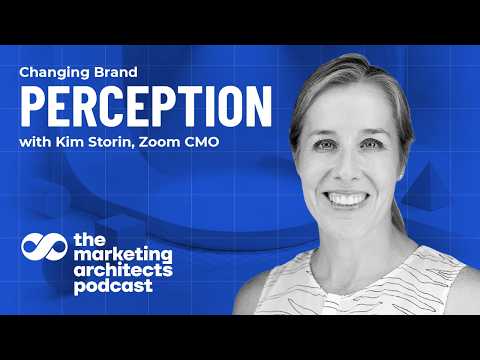
Changing Brand Perception with Kim Storin, CMO of Zoom
Zoom has incredibly high brand awareness. But that's actually part of the problem.
This week, Elena, Angela, and Rob sit down with Kim Storin, Chief Marketing and Communications Officer at Zoom, to dig into one of marketing's most counterintuitive challenges: too much awareness for the wrong thing. Kim shares how she diagnosed Zoom's perception problem, rebuilt the brand's health measurement from scratch, and launched a campaign strategy rooted in category thinking, humor, and hard data.
Topics Covered
• [02:30] Mental availability vs. awareness
• [06:00] Reinventing brand health measurement to track new buying cohorts
• [08:30] "Brand to demand" and why Kim refuses to separate the two
• [11:00] Marketing in the dark funnel and the shift toward a zero-click world
• [15:00] Building a new category narrative around Zoom
• [19:00] The thinking behind the "Take Back Lunch" campaign
• [24:00] How AI-driven B2B search is changing citation strategy, content and credibility
Resources:
2011 Byron Sharp Article
Kim's LinkedIn
Today's Hosts

Elena Jasper
CMO

Rob DeMars
Chief Product Architect

Angela Voss
Chief Executive Officer

Kim Storin
Chief Marketing and Communications Officer at Zoom
Transcript
Elena: I'm Elena Jasper. I run the marketing team here at Marketing Architects, and I'm joined by my co-hosts, Angela Voss, the CEO of Marketing Architects, and Rob DeMars, the chief product architect at Misfits & Machines.
Rob: Hello.
Angela: Hey, guys.
Elena: And we have a guest today, Kim Storin. Kim is the chief marketing and communications officer at Zoom. Before Zoom, she was the CMO at Zayo Group, where she built the marketing function from the ground up. She's also led brand turnarounds at IBM, where she delivered seven consecutive quarters of revenue growth, and at AMD, where she laid the groundwork for a new brand strategy that fueled massive stock gains.
Kim: Yeah, I saw AMD just hit like $300. I'm like, we won't even talk about... it was like a $2 stock back in the day.
Rob: Well, Kim, word on the street is you're also, like, the chief marathon officer. You did, like, 14 marathons.
Kim: I haven't run one since 2019, so I'm having a little bit of an identity crisis of, can I still call myself a long distance runner if 13 miles is kinda my longest distance.
Angela: You've been busy.
Elena: Yeah.
Kim: Yes. It's my, like, stress relief.
Elena: Yeah. Curious, Kim, what was your favorite marathon? Just for my own curiosity.
Kim: I don't have her anymore, let her rest in peace, but at the time I named my dog after the halfway point in the Big Sur Marathon because I loved it so much and it was just so beautiful, which was the Bixby Canyon Bridge. And Bixby's no longer with us, but she was my little marathon dog for a long time.
Elena: Fun. Did you take her on runs and stuff?
Kim: Yeah, she would do like 10 to 13, sometimes even more miles a week.
Elena: Yeah. That's great. I'm just starting to run with my dog. I'm trying to train her up. Right now, randomly she'll see — she's a bird dog, so randomly she'll see a duck or a sparrow and just completely pull me off the trail. So I'm trying to work on focus.
Kim: My dog now, Zora, is very similar to that. So, like, 90% of the time she's a great runner and she'll do up to about eight or nine. And then every once in a while, you feel like your arm gets pulled out of the socket. So not as disciplined.
Elena: Yeah. Fun. All righty. Well, I'm gonna kick us off as I always do with some research, and for this episode, I chose a classic article from Byron Sharp. This one's called "Mental Availability is Not Awareness, Brand Salience is Not Awareness." And just first defining some terms here.
Kim: So I would say we do have a brand awareness challenge, but not in the way that you would think, right? Which is that it is a double-edged sword. We have 99% brand awareness, so for a CMO, that sounds really great on paper, right? You have this huge awareness opportunity. But what it really means when your business is known for one thing and one thing only, that becomes a double-edged sword. And so that is, I mean, to the point you just raised in terms of the research, right? We are constantly top of mind, but we are very much underrepresented in too many buying situations. And people don't necessarily understand the breadth and depth of the portfolio, and so we're always top of mind for meetings and, you know, for video conferencing.
Elena: That's such an interesting challenge. I think when we talk to a lot of brands that are getting into sort of the brand marketing journey, they're so focused on their awareness metrics, their aided and unaided awareness, and moving those over time. When those high-level metrics aren't really telling you what you need to know since you're already so high, how does your measurement framework work?
Kim: So it started with — our brand health was really only looking at the use case that we were already well positioned in, and it was only looking at the buyers that are looking at that one use case. And so ultimately we had to reinvent our entire brand health approach because for the expanded portfolio, we're actually selling to different buying groups, right?
Elena: So it's almost like before you were running, like, one big brand health survey, and now you're slicing and dicing more of the different audiences. Yeah. One thing I was curious about is there's always this balance CMOs need to have between brand and pipeline, and it probably shouldn't be seen as so separate.
Kim: I think they are inherently tied together. So even the way that I message it is I talk about it as brand to demand. I don't talk about brand, I don't talk about demand. I talk about brand to demand because if you really think about it, your demand efficiency and effectiveness comes from having a really strong baseline at the top of the funnel.
Angela: 100%. I wanna double-click into dark funnel just in case we have listeners that are hearing that term for the first time. It's just that portion of the buyer journey that happens outside of any trackable marketing touchpoints, right? The research, the conversations, preference formation that might occur before a prospect ever raises their hand or enters your CRM.
Kim: Yeah, so I think it is a very different mindset. And when you start to think about the fact that we're moving to a zero-click world, and in B2B — which is a lot of where Zoom plays, right? Yes, we have a lot of freemium users, but when you think about it, our core business is a B2B business at the heart of it.
Angela: 100%. We've talked about how the potential of a zero-click world could actually make the marketing world and industry just more effective in general. It's simple — we need to be where our potential consumers are, but it forces us to let go of some of the data and the last click that we may have been addicted to. And it pushes us into a world in which we have to really subscribe to a belief system, and I love that.
Kim: Absolutely. I think it really starts with the work that we've done, and I've partnered with our CFO — which is not always the number one partner for marketing, but my dad is an ex-CFO, and I've been reconciling receipts since I was 10 years old. So I always gravitate towards the CFO cohort there.
Rob: Let's talk about some more fun here, 'cause I really enjoyed watching your commercial for your Zoom Ahead 📝 launch. You've described the commercial as Dead Poets Society meets Severance.
Kim: Yeah, so I mean, ultimately we knew that we needed to do something big. Reach matters, repetition matters, credibility matters. And so we wanted to figure out in this campaign how we bring those things to life. So it was a pretty broad scale campaign. We showed up in a lot of really cultural moments, everywhere from the college football championship to the Grammys to the Olympics and more.
Rob: Is his firm located on the Staten Island Ferry that he bought?
Kim: Maybe some days, 'cause I think it's a small team, so you never know where they're gonna be. We really wanted to bring some heart and humanity. We looked at what the competition was doing, and we felt like there was an opening. We are part of the cultural zeitgeist and a lot of that is organic.
Rob: And you guys really tapped into — I think you said at the beginning of this — is like people do take video conferencing seriously even though it's not a serious topic. But like I get mad if I get invited to a Teams meeting, right?
Kim: Yeah, absolutely.
Rob: Speaking of another fun topic, let's hit on AI for a minute. I love getting a software update from Zoom 'cause it seems like you guys are always giving new gifts every time, and the AI integration into it is continuing to be top tier. How does that impact all the LLMs and the AI-driven search? How does that seem to be changing the B2B buyer journey? And does that really factor in how you guys think about where Zoom needs to show up?
Kim: Oh, absolutely. Obviously, to your point, we are an AI company. We're building AI into our products. We just launched an AI notes product — it's embedded into the product, it's not bolted on. And we eat our own dog food, we use our own products, and so we are big believers in the future of AI and the future of AI as part of what we're building.
Elena: Yeah. I appreciate you giving examples of how you're addressing some of the AEO challenges, like press releases and FAQs and... 'Cause as a B2B marketer myself, it can be so overwhelming. It feels like the recommendations change. It's not the same as SEO, but we're doing some similar things. I'm always like, "Oh, okay, good. That's good that a brand like Zoom is doing that, too." This has been wonderful. I love all these topics. I love how plugged in you are to marketing effectiveness, especially at a B2B brand, which I think is not quite as common. Love brand to demand, use of humor. I was reading some research the other day about how humor-driven campaigns are much more likely to be effective, but it's hard to get it right...
Kim: That's why you gotta call somebody like Colin, because if you try to take that on yourself, you'll probably fail.
Elena: No, you wouldn't wanna hire me for that. The dark funnel, brand health metrics — it's just been wonderful talking to you. I wanted to wrap up with something kind of fun. On the same theme of perception we've been talking about today, what is something that people consistently get wrong about you when they first meet you?
Kim: So this is a cop-out answer, but I think it kinda ties into this concept of authenticity and credibility. With me, like what you see is what you get, and so I think people are often surprised — I don't put on too much of a veneer and I tell how it is. And it's a little bit of, you know, the Texan in me.
Elena: No, that's nice.
Kim: I need to figure out how to have people getting something wrong about me. But usually they can read me like a book.
Angela: This was a hard one. I said that to Elena yesterday when we were prepping for this. But I love social settings in very limited scope. I think that people assume that I'm more social than I actually am. I have JOMO instead of FOMO. I go to bed at 8:00 PM routinely.
Elena: What about you, Rob?
Rob: I happen to be a dude, so people think that I somehow might even remotely wanna watch professional sports. The truth is, I know way more about New Girl than I do about the New York Yankees. So I just have no interest in talking professional sports.
Kim: I was at the dentist two weeks ago, and the dentist walks in trying to make small talk. "So what sports do you like watching?" And I'm just like, "Wrong guy."
Rob: Oh, Dawson, for sure.
Kim: All right. I did meet James Van Der Beek. He was in a sushi restaurant the night before July 4th, like two years ago. And of course, we were the only people in the restaurant, and I'm like staring at him and his family, and my husband's German and he has no understanding. And I was like, "My high school friend text thread is gonna go crazy for this." And so, you know, my husband went to the car. I went and interrupted — and was like, "Will you take a photo with me?" So I have this great photo of me and Dawson. And at the end of it, I said to him, "I was always Team Dawson," and he laughed. And then I got in the car, and I said to my husband, "I had to lie to him. I was so Team Pacey." But I just felt like, you know, I needed to give him something for taking that photo and letting me interrupt his family dinner.
Rob: Of course you're gonna be Team Dawson in that moment — kidding? For sure. That's awesome.
Elena: Well, mine is that I'm pretty tall. I'm six feet tall, and people always ask me if I played basketball. I get it at least a couple times a year. Did not play basketball, not good at basketball. I tried. Angela actually played basketball in college — Angela's a bit taller than me.
Angela: Yep. That for sure is out there if we're tall.
Kim: Well, try out the notes feature if you haven't yet.
Elena: Yep, I see that pop up.
Rob: The Claude Connector has been a game changer, too.
Kim: I love it. It's all part of the ecosystem now. I love it.
Elena: All right. Thank you so much for joining us, Kim. That was fun.
Kim: Thank you.
Episode 164
Changing Brand Perception with Kim Storin, CMO of Zoom
Zoom has incredibly high brand awareness. But that's actually part of the problem.
This week, Elena, Angela, and Rob sit down with Kim Storin, Chief Marketing and Communications Officer at Zoom, to dig into one of marketing's most counterintuitive challenges: too much awareness for the wrong thing. Kim shares how she diagnosed Zoom's perception problem, rebuilt the brand's health measurement from scratch, and launched a campaign strategy rooted in category thinking, humor, and hard data.
Topics Covered
• [02:30] Mental availability vs. awareness
• [06:00] Reinventing brand health measurement to track new buying cohorts
• [08:30] "Brand to demand" and why Kim refuses to separate the two
• [11:00] Marketing in the dark funnel and the shift toward a zero-click world
• [15:00] Building a new category narrative around Zoom
• [19:00] The thinking behind the "Take Back Lunch" campaign
• [24:00] How AI-driven B2B search is changing citation strategy, content and credibility
Resources:
2011 Byron Sharp Article
Kim's LinkedIn
Today's Hosts
Elena Jasper
CMO
Rob DeMars
Chief Product Architect
Angela Voss
Chief Executive Officer
Kim Storin
Chief Marketing and Communications Officer at Zoom
Subscribe on



Enjoy this episode? Leave us a review.
Transcript
Elena: I'm Elena Jasper. I run the marketing team here at Marketing Architects, and I'm joined by my co-hosts, Angela Voss, the CEO of Marketing Architects, and Rob DeMars, the chief product architect at Misfits & Machines.
Rob: Hello.
Angela: Hey, guys.
Elena: And we have a guest today, Kim Storin. Kim is the chief marketing and communications officer at Zoom. Before Zoom, she was the CMO at Zayo Group, where she built the marketing function from the ground up. She's also led brand turnarounds at IBM, where she delivered seven consecutive quarters of revenue growth, and at AMD, where she laid the groundwork for a new brand strategy that fueled massive stock gains.
Kim: Yeah, I saw AMD just hit like $300. I'm like, we won't even talk about... it was like a $2 stock back in the day.
Rob: Well, Kim, word on the street is you're also, like, the chief marathon officer. You did, like, 14 marathons.
Kim: I haven't run one since 2019, so I'm having a little bit of an identity crisis of, can I still call myself a long distance runner if 13 miles is kinda my longest distance.
Angela: You've been busy.
Elena: Yeah.
Kim: Yes. It's my, like, stress relief.
Elena: Yeah. Curious, Kim, what was your favorite marathon? Just for my own curiosity.
Kim: I don't have her anymore, let her rest in peace, but at the time I named my dog after the halfway point in the Big Sur Marathon because I loved it so much and it was just so beautiful, which was the Bixby Canyon Bridge. And Bixby's no longer with us, but she was my little marathon dog for a long time.
Elena: Fun. Did you take her on runs and stuff?
Kim: Yeah, she would do like 10 to 13, sometimes even more miles a week.
Elena: Yeah. That's great. I'm just starting to run with my dog. I'm trying to train her up. Right now, randomly she'll see — she's a bird dog, so randomly she'll see a duck or a sparrow and just completely pull me off the trail. So I'm trying to work on focus.
Kim: My dog now, Zora, is very similar to that. So, like, 90% of the time she's a great runner and she'll do up to about eight or nine. And then every once in a while, you feel like your arm gets pulled out of the socket. So not as disciplined.
Elena: Yeah. Fun. All righty. Well, I'm gonna kick us off as I always do with some research, and for this episode, I chose a classic article from Byron Sharp. This one's called "Mental Availability is Not Awareness, Brand Salience is Not Awareness." And just first defining some terms here.
Kim: So I would say we do have a brand awareness challenge, but not in the way that you would think, right? Which is that it is a double-edged sword. We have 99% brand awareness, so for a CMO, that sounds really great on paper, right? You have this huge awareness opportunity. But what it really means when your business is known for one thing and one thing only, that becomes a double-edged sword. And so that is, I mean, to the point you just raised in terms of the research, right? We are constantly top of mind, but we are very much underrepresented in too many buying situations. And people don't necessarily understand the breadth and depth of the portfolio, and so we're always top of mind for meetings and, you know, for video conferencing.
Elena: That's such an interesting challenge. I think when we talk to a lot of brands that are getting into sort of the brand marketing journey, they're so focused on their awareness metrics, their aided and unaided awareness, and moving those over time. When those high-level metrics aren't really telling you what you need to know since you're already so high, how does your measurement framework work?
Kim: So it started with — our brand health was really only looking at the use case that we were already well positioned in, and it was only looking at the buyers that are looking at that one use case. And so ultimately we had to reinvent our entire brand health approach because for the expanded portfolio, we're actually selling to different buying groups, right?
Elena: So it's almost like before you were running, like, one big brand health survey, and now you're slicing and dicing more of the different audiences. Yeah. One thing I was curious about is there's always this balance CMOs need to have between brand and pipeline, and it probably shouldn't be seen as so separate.
Kim: I think they are inherently tied together. So even the way that I message it is I talk about it as brand to demand. I don't talk about brand, I don't talk about demand. I talk about brand to demand because if you really think about it, your demand efficiency and effectiveness comes from having a really strong baseline at the top of the funnel.
Angela: 100%. I wanna double-click into dark funnel just in case we have listeners that are hearing that term for the first time. It's just that portion of the buyer journey that happens outside of any trackable marketing touchpoints, right? The research, the conversations, preference formation that might occur before a prospect ever raises their hand or enters your CRM.
Kim: Yeah, so I think it is a very different mindset. And when you start to think about the fact that we're moving to a zero-click world, and in B2B — which is a lot of where Zoom plays, right? Yes, we have a lot of freemium users, but when you think about it, our core business is a B2B business at the heart of it.
Angela: 100%. We've talked about how the potential of a zero-click world could actually make the marketing world and industry just more effective in general. It's simple — we need to be where our potential consumers are, but it forces us to let go of some of the data and the last click that we may have been addicted to. And it pushes us into a world in which we have to really subscribe to a belief system, and I love that.
Kim: Absolutely. I think it really starts with the work that we've done, and I've partnered with our CFO — which is not always the number one partner for marketing, but my dad is an ex-CFO, and I've been reconciling receipts since I was 10 years old. So I always gravitate towards the CFO cohort there.
Rob: Let's talk about some more fun here, 'cause I really enjoyed watching your commercial for your Zoom Ahead 📝 launch. You've described the commercial as Dead Poets Society meets Severance.
Kim: Yeah, so I mean, ultimately we knew that we needed to do something big. Reach matters, repetition matters, credibility matters. And so we wanted to figure out in this campaign how we bring those things to life. So it was a pretty broad scale campaign. We showed up in a lot of really cultural moments, everywhere from the college football championship to the Grammys to the Olympics and more.
Rob: Is his firm located on the Staten Island Ferry that he bought?
Kim: Maybe some days, 'cause I think it's a small team, so you never know where they're gonna be. We really wanted to bring some heart and humanity. We looked at what the competition was doing, and we felt like there was an opening. We are part of the cultural zeitgeist and a lot of that is organic.
Rob: And you guys really tapped into — I think you said at the beginning of this — is like people do take video conferencing seriously even though it's not a serious topic. But like I get mad if I get invited to a Teams meeting, right?
Kim: Yeah, absolutely.
Rob: Speaking of another fun topic, let's hit on AI for a minute. I love getting a software update from Zoom 'cause it seems like you guys are always giving new gifts every time, and the AI integration into it is continuing to be top tier. How does that impact all the LLMs and the AI-driven search? How does that seem to be changing the B2B buyer journey? And does that really factor in how you guys think about where Zoom needs to show up?
Kim: Oh, absolutely. Obviously, to your point, we are an AI company. We're building AI into our products. We just launched an AI notes product — it's embedded into the product, it's not bolted on. And we eat our own dog food, we use our own products, and so we are big believers in the future of AI and the future of AI as part of what we're building.
Elena: Yeah. I appreciate you giving examples of how you're addressing some of the AEO challenges, like press releases and FAQs and... 'Cause as a B2B marketer myself, it can be so overwhelming. It feels like the recommendations change. It's not the same as SEO, but we're doing some similar things. I'm always like, "Oh, okay, good. That's good that a brand like Zoom is doing that, too." This has been wonderful. I love all these topics. I love how plugged in you are to marketing effectiveness, especially at a B2B brand, which I think is not quite as common. Love brand to demand, use of humor. I was reading some research the other day about how humor-driven campaigns are much more likely to be effective, but it's hard to get it right...
Kim: That's why you gotta call somebody like Colin, because if you try to take that on yourself, you'll probably fail.
Elena: No, you wouldn't wanna hire me for that. The dark funnel, brand health metrics — it's just been wonderful talking to you. I wanted to wrap up with something kind of fun. On the same theme of perception we've been talking about today, what is something that people consistently get wrong about you when they first meet you?
Kim: So this is a cop-out answer, but I think it kinda ties into this concept of authenticity and credibility. With me, like what you see is what you get, and so I think people are often surprised — I don't put on too much of a veneer and I tell how it is. And it's a little bit of, you know, the Texan in me.
Elena: No, that's nice.
Kim: I need to figure out how to have people getting something wrong about me. But usually they can read me like a book.
Angela: This was a hard one. I said that to Elena yesterday when we were prepping for this. But I love social settings in very limited scope. I think that people assume that I'm more social than I actually am. I have JOMO instead of FOMO. I go to bed at 8:00 PM routinely.
Elena: What about you, Rob?
Rob: I happen to be a dude, so people think that I somehow might even remotely wanna watch professional sports. The truth is, I know way more about New Girl than I do about the New York Yankees. So I just have no interest in talking professional sports.
Kim: I was at the dentist two weeks ago, and the dentist walks in trying to make small talk. "So what sports do you like watching?" And I'm just like, "Wrong guy."
Rob: Oh, Dawson, for sure.
Kim: All right. I did meet James Van Der Beek. He was in a sushi restaurant the night before July 4th, like two years ago. And of course, we were the only people in the restaurant, and I'm like staring at him and his family, and my husband's German and he has no understanding. And I was like, "My high school friend text thread is gonna go crazy for this." And so, you know, my husband went to the car. I went and interrupted — and was like, "Will you take a photo with me?" So I have this great photo of me and Dawson. And at the end of it, I said to him, "I was always Team Dawson," and he laughed. And then I got in the car, and I said to my husband, "I had to lie to him. I was so Team Pacey." But I just felt like, you know, I needed to give him something for taking that photo and letting me interrupt his family dinner.
Rob: Of course you're gonna be Team Dawson in that moment — kidding? For sure. That's awesome.
Elena: Well, mine is that I'm pretty tall. I'm six feet tall, and people always ask me if I played basketball. I get it at least a couple times a year. Did not play basketball, not good at basketball. I tried. Angela actually played basketball in college — Angela's a bit taller than me.
Angela: Yep. That for sure is out there if we're tall.
Kim: Well, try out the notes feature if you haven't yet.
Elena: Yep, I see that pop up.
Rob: The Claude Connector has been a game changer, too.
Kim: I love it. It's all part of the ecosystem now. I love it.
Elena: All right. Thank you so much for joining us, Kim. That was fun.
Kim: Thank you.